Implementing data governance frameworks: From principles to practice
Executive summary
Data governance has become part of the basic machinery of digital government. It determines whether public institutions can find and understand the data they hold, whether information can be exchanged securely across organizational boundaries, whether people and businesses can exercise meaningful rights, and whether data can be reused for public services, research, competition and artificial intelligence (AI). Adopting a data governance law, strategy, or set of principles is only a first step. Data governance becomes operational when institutions assign clear responsibilities, use common standards, process requests to access and share data, connect systems securely, improve the quality of source data, and fund ongoing operations. It also requires clear accountability for how data are collected, accessed, shared, protected, and used, including both the public benefits created and any harm caused by poor data quality, misuse, or weak safeguards.
This article complements the article on Navigating data governance: A guiding tool for regulators by examining how governments and regional organizations are transitioning from policy commitments to operational practice in data governance.[1] It also links data governance to ITU’s guide on Collaborative AI Frameworks and Preparedness Diagnostic. With respect to preparedness, AI systems depend on data that are lawfully available, sufficiently relevant and representative, documented, secure and fit for a defined purpose. Weak data provenance, inconsistent identifiers, inaccessible local-language data and poor administrative records can undermine the implementation of an AI system even where computing capacity and technical talent are available. Opening access to data without adequate controls can also deepen cybersecurity risks and reinforce market concentration.[2]
The article examines six implementation approaches to data governance: (i) central coordination with responsibilities distributed across data-holding institutions; (ii) shared exchange infrastructure and authoritative data; (iii) regulatory implementation through guidance, compliance services and assurance; (iv) statistical stewardship of quality, metadata and standards; (v) sectoral or high-value use cases that give institutions a concrete reason to cooperate; and (vi) regional coordination through common instruments. Most jurisdictions combine several of these approaches.
Illustrative experiences are drawn from selected countries and regional organizations around the world. They include Brazil, Colombia, the Czech Republic, Estonia, Kazakhstan, Malaysia, Rwanda, Saudi Arabia, Singapore, Ukraine, the African Union, ASEAN, the European Union and the Organization of American States. South Africa and Nigeria provide additional African examples of policy implementation, statistical quality assurance and regulatory compliance. The examples are not rankings, endorsements or comprehensive country assessments. They are based on publicly available laws, policies, regulatory guidance, official platforms, procurement documents and implementation reports. The analysis distinguishes among measures that have been adopted, measures that are operational, measures being scaled, and measures with credible outcome evidence.
Across the cases reviewed, one institutional pattern appears repeatedly. Effective data governance systems usually combine a central coordinating institution with distributed responsibility. A ministry, regulator, national data authority, digital agency or statistics office can set common rules, maintain an architecture and resolve disputes. The institution that creates and holds the data should remain answerable for its quality, classification, security, lawful disclosure and continued maintenance. To illustrate this, Saudi Arabia formalizes this division of responsibility through a central authority and entity-level data management offices. Rwanda combines national stewardship and common standards with responsibilities in participating public bodies. Brazil’s Digital Government Secretariat acts as an intermediary and financier between data providers and service agencies. Estonia connects independently managed systems through a common exchange layer rather than a central database.
Shared digital public infrastructure and data governance need to develop together. Brazil’s Conecta GOV.BR, Malaysia’s MyGDX, Estonia’s X-tee, Kazakhstan’s Smart Data Ukimet and Saudi Arabia’s Government Service Bus show how APIs, exchange layers, trusted registers and data marketplaces can reduce repeated verification and support integrated services through data governance.
Regional bodies add practical value by reducing fragmentation, promoting common approaches to data management and improving interoperability across national systems. ASEAN’s Data Management Framework and Model Contractual Clauses offer reusable organizational and contractual tools across diverse legal systems. The OAS Inter-American Framework on Data Governance and Artificial Intelligence provides guidelines, a regional study, and a model policy developed through collaboration. The African Union Data Policy Framework sets a continental direction, and subsequent work on implementation instruments shows that operationalization is still developing. The European Union has gone further toward binding legal harmonization through the Data Governance Act, the Data Act and sectoral data spaces. The EU experience also illustrates the coordination costs created by regulatory layering and uneven national capacity.[3]
Recent practice also shows regulators becoming involved earlier in the implementation process, rather than intervening only after a violation. For example, Singapore’s Personal Data Protection Commission has paired legal supervision with implementation guidance, self-assessment tools and technical testing.[4] Nigeria’s Data Protection Commission has translated the 2023 Act into a detailed General Application and Implementation Directive, registration, audit and complaint processes.[5] The Czech Telecommunications Office illustrates how the remit of an ICT and communications regulator can expand to include responsibilities under the national implementation of the EU Digital Services Act, the Data Governance Act and the Data Act. These examples also show the value of clear referral arrangements among data protection, competition, cybersecurity, sectoral and ICT authorities.
National statistics offices also deserve a more explicit place in data governance. Their experience with classifications, metadata, administrative records, confidentiality, quality assessment and public-interest access is directly relevant to AI-ready data. Colombia’s 2023 Official Statistics Law strengthens the National Administrative Department of Statistics’ (DANE) stewardship role in the National Statistical System and its work on the Colombian State Data Infrastructure. Rwanda’s statistics authority leads national data governance standards. Statistics South Africa’s quality assessment framework provides a transparent method for assessing and certifying official statistics. National statistics offices cover only part of the data governance agenda. Their involvement helps keep questions of quality, metadata and evidence alongside legal, regulatory and infrastructure concerns.
A government-wide effort to share data or purchase a national platform is rarely the most practical starting point. A more workable approach begins with identifying a manageable set of public-interest data uses, mapping the institutions and legal powers involved, establishing minimum rules and standards for those data uses, improving the source data, and determining how costs, oversight and redress will operate. Regulators should combine practical guidance and supervised implementation with proportionate enforcement. Regional organizations can reduce avoidable divergence among their member states through common terminology, model instruments, interoperability support and peer learning, with countries sequencing reforms according to their own capacity. Progress in implementing data-governance frameworks is measured through actual use, data quality, secure access, correction and complaint procedures, inclusion and public value, rather than the number of strategies, committees or datasets announced.
1. Introduction: why implementation has become the central question in data governance
Data now sits inside almost every major digital-policy objective. Public authorities rely on administrative information to pay benefits, collect revenue, manage public health, plan infrastructure, supervise markets and evaluate programs. Businesses use data to manage supply chains, assess risk and design services. Researchers, journalists and civil society use it to produce knowledge and scrutinize public power. AI intensifies these dependencies because models need access to data as well as reliable information about where the data came from, what it represents, how it was transformed, which rights attach to it and whether it remains suitable after deployment.
The growing importance of data has produced a dense body of law and policy. Data protection rules govern the processing of personal information. Open-data policies seek to make public information discoverable and reusable. Cybersecurity frameworks protect confidentiality, integrity and availability. Competition authorities examine control over strategic datasets and data-driven market power. Sector regulators govern health, finance, telecommunications, energy, transport and other specialized information. Digital-government agencies build identity, payment, cloud and exchange systems. Statistics offices maintain classifications and quality standards. Ministries responsible for innovation and AI seek data access for research and deployment. Each of these objectives has a legitimate place in data governance. Problems arise when institutions pursue them separately, using incompatible terminology and disconnected technical systems.
The guiding tool organized data governance around data classification, interoperability, availability, quality and integrity, access and sharing, security, privacy, governance structures and documentation. This article builds on that foundation and asks what happens next. It is concerned with whether legal authority has been translated into repeatable processes, whether the responsible institutions have staff, skills and budgets, whether systems can exchange information securely, whether data holders have incentives to participate, whether affected people can challenge misuse or error, and whether governments can tell if the framework is producing public value.
In practice, the implementation gap appears in several parts of the system. Effective data governance depends on the institutions, standards, resources, and procedures needed to put policy into practice. Agencies need clear technical standards, shared identifiers and metadata, reliable ways to identify authoritative data sources, and agreed security conditions for data sharing. Regulators and data protection authorities also need sufficient technical expertise and stable funding to carry out their responsibilities. Pilot projects require lasting arrangements for onboarding, maintenance, financing, and incident response. At the regional level, common high-level principles should be supported by practical procedures for contracts, mutual assistance, and cross-border complaints. Without these foundations, strategies and pilot projects are likely to remain fragmented or lose momentum.
AI exposes these weaknesses quickly in public administration. Therefore, successful implementation of a national AI strategy depends on public institutions having lawful, reliable, and well-governed data. For example, a health ministry developing an AI tool to identify patients at higher risk needs to know which records are complete and representative, and whether past gaps in access to healthcare are reflected in the data. In another example, a tax authority using AI to flag unusual transactions needs clear rules for accessing sensitive information, documenting how data are used, and allowing people to correct inaccurate records. A government developing a local-language model may need to combine public, proprietary, and cross-border datasets, each with different legal, sensitivity, and security conditions. How governments answer these questions will shape whether AI systems can move from policy ambition to reliable public use.[6]
This is why data governance for AI must perform two tasks at once. It should enable responsible access to high-value data, including data held by government, regulated industries, research institutions and private firms. It should also impose limits, documentation and accountability where data use can affect rights, safety, competition or public trust. A data governance system that focuses only on restrictions may prevent beneficial research and entrench incumbents with privileged access. A system focused mainly on availability can create a different set of problems, including excessive collection, opaque reuse and insecure concentration. The practical objective is neither maximum sharing nor maximum control. It is predictable, proportionate, and accountable data access for legitimate purposes.
Implementation therefore depends on connecting six functions: strategic direction, legal authority, institutional coordination, operational rules, technical infrastructure, and accountability and learning. Different jurisdictions assign these functions to different bodies (see Figure 1). Some use a central data authority. Others rely on a digital-government agency, a statistics office, a network of independent regulators or a regional legal framework. No single institutional chart is inherently the best. The institutional configuration can vary as long as these functions are covered, responsibilities are understood, and conflicts can be resolved as data uses change.
Figure 1. Data governance as an implementation system
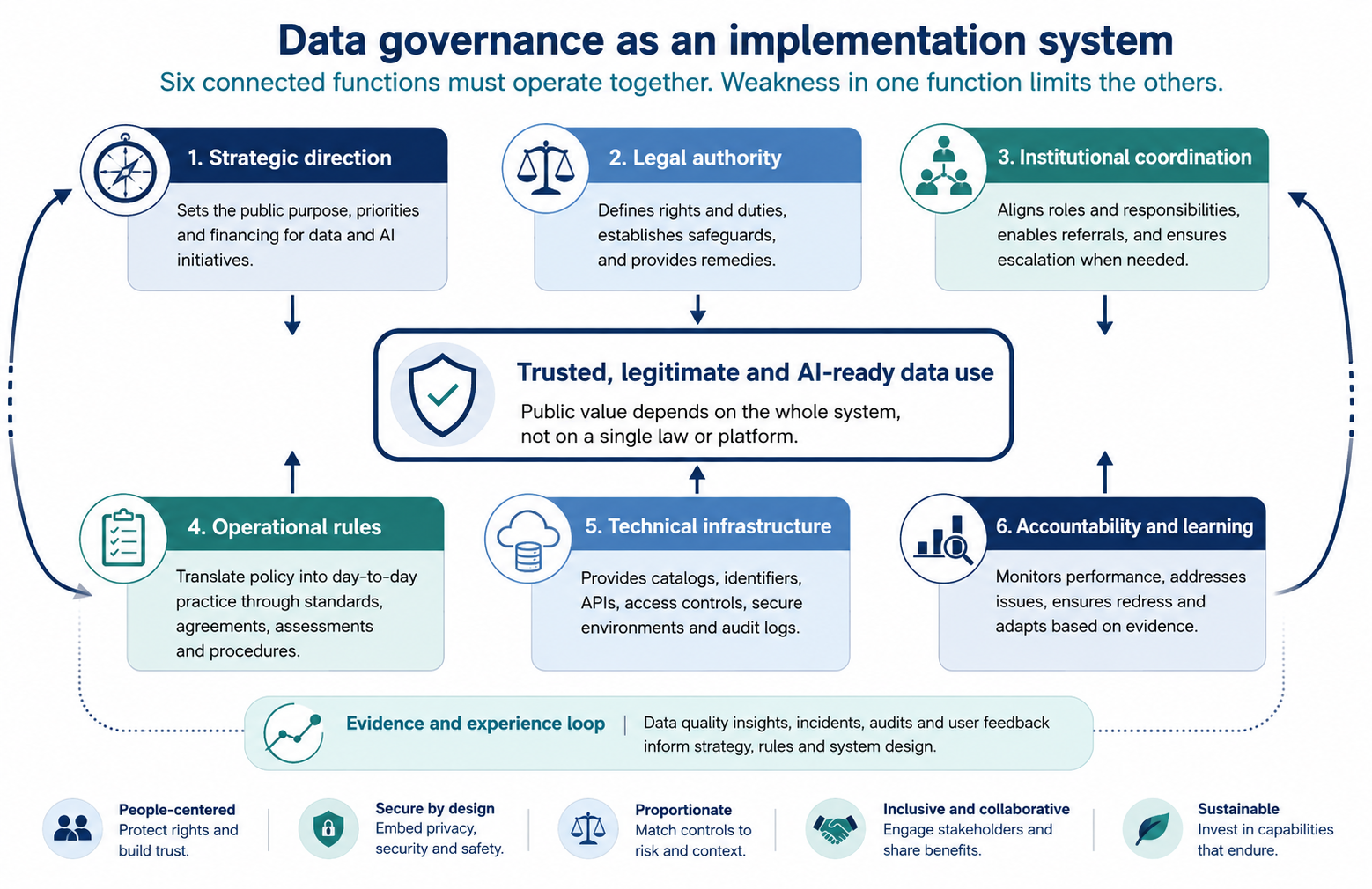
Source: Author’s analysis based on the implementation evidence discussed in this article.
2. Method and analytical framework
The article uses a comparative review of illustrative implementation experiences across the world. It draws on publicly available laws, policies, standards, regulatory guidance, government platforms, procurement documents, official performance reporting and regional instruments. Other multilateral sources are used where they provide independent analysis of institutional coordination or public-sector implementation.
Each example was selected to illustrate a particular implementation mechanism. None is presented as a complete or ideal national system. Rwanda shows how a continental policy can be translated into a detailed national package of standards, agreements and planned infrastructure. Brazil and Malaysia show how a government can make data exchange a funded operational service. Saudi Arabia illustrates a centralized authority combined with data functions inside public entities. Singapore and Nigeria show regulators using guidance, digital services and assurance mechanisms to move beyond abstract compliance. Colombia, Rwanda and South Africa demonstrate the contribution of national statistics institutions to quality, metadata and stewardship. Kazakhstan shows the opportunities and risks of using integrated administrative data for proactive services. Estonia demonstrates mature distributed interoperability. The Czech Republic highlights the expanding role of an ICT regulator in the wider digital economy. The European Union, ASEAN, the African Union and the OAS illustrate different forms of regional alignment. Ukraine illustrates how standardized open procurement data can support access by businesses, researchers, journalists and civil society.
Public announcements alone do not show that a data governance framework has been put into practice. The article examines the available sources to distinguish between policies, tools and services that have been formally approved, those already being used and those being extended to more institutions, services or users. Each is considered separately. Where results are reported, the article explains what the evidence supports and where further assessment is needed.
Section 7 draws on the examples to propose a four-phase implementation roadmap. During Diagnose and align, governments assess their starting point, identify priorities and assign responsibilities. The Collaborative AI frameworks and preparedness diagnostic supports this initial assessment. Design and enable establishes the rules, standards, safeguards, funding and complaint procedures needed for implementation. Pilot and operationalize tests selected services under real conditions, examining data quality, security, people’s experience of using the services and their ability to get problems resolved. Scale, enforce and adapt expands approaches that have demonstrated value, makes them part of regular government operations and uses monitoring and enforcement to address weaknesses. The roadmap reflects the continuing work involved in implementation. Progress is not always linear: lessons from testing or wider use may require governments to revisit earlier decisions and adjust their approach.
The analysis also avoids attributing a single result to a single institution. Data governance outcomes usually come from a chain of actors: policy ministries, legislatures, regulators, platform operators, data-holding agencies, vendors, sector bodies, and users.
Table 1. Common analytical framework for data governance implementation
|
Implementation function |
Core implementation question |
Evidence considered |
|
1. Strategic direction |
Is there a clear public purpose for data governance, and are priorities for data, digital government, cybersecurity, competition, sectoral policies and AI aligned with that purpose and supported by financing? |
National and sectoral strategies, implementation plans, investment priorities, budget allocations, institutional roadmaps and priority data or AI use cases
|
|
2. Legal authority |
Do public and private actors have sufficiently clear rights, duties and lawful authority to collect, access, share and reuse data, with appropriate safeguards, remedies and enforcement powers? |
Laws, regulations, regulatory guidance, judicial or administrative decisions, contractual instruments, data-sharing provisions, rights and remedies
|
|
3. Institutional coordination |
leadership, ownership and decision-making responsibilities clear, and are there workable arrangements for resolving overlaps, referrals and disputes across institutions? |
Institutional mandates, governance bodies, data offices, stewardship arrangements, coordination mechanisms, referral procedures, escalation pathways and regulator-to-regulator arrangements |
|
4. Operational rules |
Can authorized users reliably discover, understand, access and exchange data through secure and interoperable technical systems? |
Standards, data-sharing agreements, operating procedures, data classifications, risk and impact assessments, authorization procedures, procurement requirements and implementation guidance |
|
5. Technical infrastructure |
Can authorized users reliably discover, understand, access and exchange data through secure and interoperable technical systems? |
Data catalogs and registers, metadata standards, common identifiers, APIs, interoperability or exchange layers, authentication and access controls, secure processing environments, audit logs and data-quality tools |
|
6. Accountability and learning |
Can institutions determine whether the system is working, identify harms or failures, provide correction and redress, and adapt rules and systems in light of evidence and user experience? |
Monitoring indicators, audits, inspections, complaints and redress mechanisms, incident reporting, enforcement actions, data-quality findings, user feedback, evaluation results and evidence of corrective action |
Source: Author’s analysis based on the sources cited in the text.
3. Six approaches to implementation
The cases reviewed represent combinations of implementation approaches. A binding regional law may still depend on national regulators and technical platforms (such is the case in the EU). A national exchange layer may rely on entity-level data stewards and sector rules. A regulator may provide guidance that becomes meaningful only when organizations can test systems and file complaints through practical services. Organizing the evidence by approach makes it possible to compare these moving parts without implying that one jurisdiction should be copied in full.
3.1 Central coordination with distributed institutional duties
Many governments worldwide have responded to data governance fragmentation by designating a central authority, ministry, or committee. A central coordinating institution can accelerate the adoption of common standards, settle institutional disputes and provide a clear point of strategic accountability. This type of coordination is particularly useful where agencies have built incompatible systems or are reluctant to share data. Problems arise when central coordination is treated as central ownership and source institutions begin to shed responsibility for quality or lawful use.
In Saudi Arabia, the Saudi Data and Artificial Intelligence Authority brings together the National Data Management Office, the National Information Center and the National Center for AI. The arrangement allows national data standards, personal data protection, shared infrastructure and AI strategy to be developed under a common institutional umbrella. The National Data Management Office sets policies, standards and controls. The National Information Center operates major government infrastructure, including the National Data Bank and exchange services.[7]
Saudi Arabia concentrates strategic direction at the center and assigns much of the day-to-day implementation to government entities. Government entities are expected to establish data management offices, governance committees, chief data officers and stewardship roles. The national Data Sharing Policy defines responsibilities for data source entities, requesting entities, entity data management offices, and the national office. It promotes reuse, a single source of truth, security, purpose limitation and documented requests. National standards extend across cataloging, quality, architecture, interoperability, open data, document management, classification, protection, and privacy.[8]
The division of responsibilities addresses a recurring problem in centrally coordinated governance systems. A central coordinating institution can issue common standards. Responsibility for the accuracy of health, tax, education or licensing registers remains with the institutions that maintain them. Entity-level offices understand the data and the service, review requests, maintain metadata, manage quality issues and coordinate with security and legal staff. The central coordinating institution focuses on common rules, assurance, shared services and escalation.
Saudi Arabia has also linked data governance into digital compliance services. The National Data Governance Platform supports registration, self-assessment, complaints and inquiries under the personal-data regime, as well as registries of controllers and service providers. The Government Service Bus and Data Marketplace provide structured routes for agencies to expose, request or subscribe to data services and APIs.[9]
The Saudi model benefits from strong central coordination and substantial implementation resources. The Saudi experience illustrates the value of pairing central coordination with designated data functions in source institutions, operational services and a clear escalation process.
Rwanda is developing a similar model through a different institutional configuration. The National Data Sharing Policy, approved in 2025, sets a government-wide framework for secure and legally compliant exchange. The Ministry of ICT and Innovation provides policy oversight, and the National Institute of Statistics of Rwanda leads national data governance principles and standards. Public bodies remain responsible for the datasets they create, including their classification, protection, documentation, and readiness for sharing.[10]
Rwanda has supported the policy with detailed operational guidance. The National Data Governance Framework and supporting guidance address classification and access, metadata, quality, standards, incident management and organizational responsibilities. The package includes model terms of reference for governance and technical bodies, a standard request process, a model data-sharing agreement and a Five Safes assessment approach.[11] These tools reduce the transaction cost of each new sharing arrangement. They also provide operational staff with more concrete guiding tools than a general instruction to cooperate.
Rwanda has already put the policy, standards and institutional design in place. The central infrastructure, onboarding process, service levels and cross-agency outcomes are still emerging. The case is best understood as a coherent operating design currently moving into implementation, not as a fully evaluated national exchange system.[12]
Malaysia has combined legislation, committee oversight, and distributed technical architecture in data governance. The Data Sharing Act 2025 establishes a structured process for data requests among federal ministries and agencies and creates a National Data Sharing Committee to assess requests against statutory criteria. The Ministry of Digital has explicitly linked the Act to faster public services, privacy protection and the data foundations needed for AI.[13] The law has created a basis for deciding whether data should be shared, rather than leaving each agency to negotiate authority over data sharing.
The Malaysian Government Central Data Exchange, MyGDX, complements this legal framework. MyGDX uses a distributed architecture. Agencies retain ownership and autonomy over their databases and rely on common security components and interfaces for exchange. Official descriptions emphasize end-to-end digital services, secure integration and reduced duplication.[14] By February 2026, the Ministry of Digital reported participation by 81 agencies across 49 integrated systems and more than 235 million API transactions.[15] The Act provides adopted legal authority, and the MyGDX figures demonstrate operational use across multiple institutions.
Saudi Arabia, Rwanda and Malaysia illustrate three different ways of organizing central coordination. It may rest in a national data and AI authority, a ministry and statistics office, or a statutory committee supported by a digital agency.
3.2 Shared exchange infrastructure and authoritative data
One practical test of data governance is whether authorized information can move between systems under clearly defined conditions. Governments have used API gateways, service buses, exchange layers, catalogs, marketplaces and secure processing environments to make this possible. The technologies differ in design. All are intended to give authorized users a reusable and secure route to discover, understand and obtain data for legitimate purposes.
Brazil’s Conecta GOV.BR illustrates an API-based public-sector model built around service delivery. The Digital Government Secretariat acts as an intermediary between data providers and consuming institutions. It identifies priority datasets, supports API development, facilitates access and monitors use. The brokerage function helps address a common incentive problem: source agencies often bear the cost and perceived risk of integration even when another institution receives most of the service benefit. A central program can finance interfaces, designate authoritative reference records and help agencies redesign procedures around reuse.[16]
The system has moved beyond pilot scale. The Brazilian government reported more than 1.1 billion data transactions through Conecta GOV.BR during 2025. Earlier G20 and OECD reporting described participation by hundreds of federal bodies and use across a large number of public services, together with government-estimated administrative savings.[17]
Brazil is also developing a broader National Data Infrastructure intended to connect governance, architecture, standards, technology, information assets and human capability. A broader national data infrastructure is needed because API exchange alone leaves questions of metadata, retention, classification, quality, open-data reuse, research access and regulatory coordination unresolved.[18]
Estonia’s X-tee provides a different architecture. It is a distributed environment for secure exchange among independently managed public and private information systems. Participating institutions retain their source systems and determine which services and data may be used by other members. Exchanges are authenticated, encrypted, signed, logged and time-stamped. The system is supported by digital identity, authoritative registers, an information-system catalog and legal recognition of digital transactions.[19]
Estonia’s distributed architecture preserves institutional control over source systems. X-tee does not require the state to move all information into a single central database. It creates a common trust and communication layer across systems that remain institutionally owned. The architecture reduces concentration risks and preserves source responsibility. It still depends on common identifiers, reliable registries, cybersecurity operations and disciplined administration. The software is only one component of a wider legal and institutional ecosystem developed over time.
Estonia also illustrates how transparency can be built into data infrastructure. Logging and citizen-facing services can make the use of personal information traceable. The national data portal supports discovery and reuse of public-sector data under the Public Information Act.[20] The same infrastructure has been adapted for cross-border public services through the EU Single Digital Gateway’s once-only technical system. In Estonia, an established national capability was extended to meet regional interoperability requirements after the domestic foundations were already in place.[21]
Kazakhstan demonstrates the service potential of integrated data. Smart Data Ukimet brings together information from government systems for analytics and proactive administration. Smart Bridge supports integration among public systems and business services. Official reporting in 2025 stated that Smart Data Ukimet integrated 124 government systems.[22] The Digital Family Card, also described as the Digital Family Map in some official materials, combines information from more than 120 sources and uses a large set of indicators to assess household well-being and identify potential eligibility for support. Government reporting said the system has supported more than 4.5 million proactive services without requiring a separate application.[23] The Digital Family Card gives participating agencies a concrete service reason to improve interfaces and data flows. The service also brings accountability questions into immediate focus. When administrative data and digital analytics are used to identify vulnerability or influence access to benefits, inaccurate or outdated records can have serious effects. People may not know which records were used, how an indicator was interpreted or how to correct an error. Proactive delivery should reduce administrative burdens, not remove explanation, human review, alternative access channels and appeal.
Kazakhstan’s 2025 AI law provides an important foundation for the responsible use of AI in public services. It sets principles for transparency, clear explanations, accountability, data protection and risk management, and places importance on preserving human autonomy in decision-making. These principles are relevant when AI supports services such as the Digital Family Card. Official figures provide evidence of operational use of Smart Data Ukimet and the Digital Family Card, and the AI law establishes adopted safeguards. As implementation develops, more public information would help residents understand which records inform an assessment, how inaccurate information is corrected, when human review is available and how decisions are appealed. Reporting on these procedures would also provide useful evidence on how the safeguards operate in practice.[24]
Four design principles appear repeatedly across the exchange systems reviewed here. Source institutions should remain accountable for their data. Access should be authenticated, purpose-bound and logged. Common metadata and authoritative registers should be developed alongside interfaces. Shared platforms should be financed and managed as continuing public services, not as one-time technology projects. Without these conditions, exchange infrastructure can spread unreliable or unlawful data use.
3.3 Regulatory implementation through guidance, compliance services and assurance
Data governance regulation is easier to implement when organizations understand what is expected of them and have practical ways to complete the required processes. Enforcement remains necessary, and regulators also have an important role earlier in the compliance process, including when organizations build inventories, conduct impact assessments and establish transfer arrangements, complaint processes or technical controls. Regulators can guide these processes through guidance, model documents, registration systems, testing, and supervised pilots (through regulatory sandboxes, for example).
Singapore’s Personal Data Protection Commission has developed one of the clearest examples of this regulator-facilitated soft approach to data governance. The Model AI Governance Framework translates high-level principles into organizational practices concerning internal governance, the appropriate level of human involvement, operations management and communication with stakeholders. The associated implementation and self-assessment guidance helps organizations examine whether their policies, processes and roles align with those practices.[25]
The Commission’s 2024 Advisory Guidelines address a more specific implementation question: how existing data-protection obligations apply to AI recommendation and decision systems. They explain how existing data-protection obligations apply when personal data are used to develop, test and deploy machine-learning systems, including questions of consent, permitted exceptions, accountability, minimization, transparency and the responsibilities of third-party developers.[26] This provides legal continuity by interpreting existing duties in the context of the AI lifecycle instead of creating a separate data regime for each technical development.
Singapore has paired this guidance with technical testing through AI Verify and with collaborative work among regulators, technical agencies and industry. AI Verify combines process checks with technical tests and is available as an open-source toolkit.[27] AI Verify gives legal, policy and engineering teams a common set of questions to work through. Technical and process testing can also identify weaknesses before deployment. Capacity remains a constraint. Large organizations are generally better equipped to maintain inventories, document models, conduct assessments and interpret voluntary guidance. Smaller firms and public bodies may need simplified templates, shared services, sector-specific support or clearer procurement rules to apply these expectations in practice. Guidance can reduce uncertainty and support implementation. Effective supervision and clear accountability remain necessary as the system matures.
Nigeria shows how a data protection authority can translate a new statute into an operational compliance framework. The Nigeria Data Protection Act 2023 established the Nigeria Data Protection Commission as the independent supervisory authority. In March 2025, the Commission issued the General Application and Implementation Directive, or GAID, under the Act. The Directive addresses records of processing, compliance audits, training, grievance notices, transfer mechanisms, data protection impact assessment, and other implementation matters.[28]
The Nigerian system also includes registration of controllers and processors of major importance, annual audit returns, complaint and breach-reporting channels, and a licensed network of Data Protection Compliance Organizations that can monitor, audit and report on compliance. Official guidance places ministries, departments and agencies within the high-importance categories for registration purposes.[29] Nigeria has created a structured compliance market and reporting chain in which licensed organizations undertake part of the audit and monitoring work under the regulator’s supervision.
This arrangement requires careful supervision. Outsourced compliance support can expand capacity and build professional expertise, and weak audit quality or unmanaged conflicts of interest can quickly turn it into a form-driven exercise. The Commission still needs the capacity to inspect, investigate, require corrective action and impose sanctions. Nigeria’s 2026 work on sector-specific frameworks for finance, telecommunications, and hospitality illustrates this next stage, where general rules are adapted to sector risks through stakeholder engagement.[30] The quality of audits, corrective action, complaint outcomes and changes in organizational practice provide a better measure of effectiveness than registration totals alone. The Act and GAID establish adopted requirements, supported by operational registration and reporting channels. Work on sector-specific guidance shows further development of the framework; its effects on audit quality, compliance and complaint outcomes require separate assessment.
The Czech Republic illustrates another route, in which an existing ICT regulator has taken on new digital-economy responsibilities. The Czech government assigned the Telecommunications Office new responsibilities in the digital economy, including the role of Digital Services Coordinator and functions associated with the national implementation of the EU’s Data Governance Act and the Data Act. The Office itself noted that these duties would require new expertise, processes and adequate financial resources.[31] The example is relevant to ICT regulators because many already supervise networks, interconnection, market conduct, consumer protection and technical standards.
An ICT regulator may be well placed to address data portability, cloud switching, interoperability, access to data generated by connected products, data-intermediation services and the interaction between data governance and digital infrastructure. It may also have experience with economic regulation and cross-border technical coordination. Those capabilities do not mean that every data-related mandate should sit with the ICT regulator. Personal-data rights, competition, cybersecurity, statistical quality and sector-specific safety may remain with other authorities. An expanded remit needs matching legal authority, specialist staff, information-sharing powers and clear referral procedures.
Implementation of the EU Data Governance Act also depends on clear allocation of responsibilities among national authorities. EU Member States must designate competent bodies to support the reuse of protected public-sector data and competent authorities for data-intermediation services and data altruism. Institutional arrangements vary, and several jurisdictions distribute responsibilities among ministries, data protection authorities, digital agencies, and sector bodies.[32] Institutional variety can work well when users can easily identify the responsible body, regulators coordinate effectively, and overlapping requirements are resolved without unnecessary delay.
Brazil’s National Data Protection Authority adds another layer to a government already operating major exchange infrastructure. The Authority oversees the General Data Protection Law and has issued rules for international transfers, including adequacy, standard contractual clauses, specific clauses and binding corporate rules.[33] Its relationship with the Digital Government Secretariat illustrates the need to distinguish platform operation from legal oversight. A digital agency can support data exchange across government, and an independent authority can retain responsibility for oversight of personal-data processing. Keeping these roles distinct helps preserve both effective coordination and independent oversight.
Taken together, the cases support a regulatory approach that becomes more demanding as risk and evidence of non-compliance increase. Regulators should begin with clear guidance, model tools, sector engagement and supervised implementation where regulatory uncertainty is genuine. They should then require proportionate evidence that organizations have put controls into practice: audits, corrective orders and sanctions should be implemented where risks are high, rights are affected or entities repeatedly fail to act.
3.4 Statistical stewardship, metadata and quality assurance
Data governance discussions often emphasize data protection law and exchange infrastructure and give much less attention to institutions that have governed data quality for decades. National statistics offices routinely work with classifications, metadata, administrative records, confidentiality, sampling, disclosure control, comparability, revision and public dissemination. These capabilities are directly relevant to AI preparedness because a model cannot compensate for data whose meaning, coverage, or limitations are unknown.
Colombia has formalized a broad statistical stewardship role through Law 2335 of 2023 on official statistics. The law provides the legal framework for planning, producing, disseminating and administering official statistics and strengthens the National Statistical System under the leadership of the National Administrative Department of Statistics, DANE. It addresses coordination, the use of administrative records, technical standards, quality assurance and the institutional responsibilities of data producers.[34] The law gives DANE a stronger stewardship role across government data, helping ensure that information used for public decision-making is consistent, well documented, and reliable. Institutions that create and maintain datasets remain responsible for them.
DANE’s work on the Colombian State Data Infrastructure, IDEC, extends this stewardship perspective beyond traditional statistical products. Official presentations describe the infrastructure as a means of improving data management, security, interoperability and policy decision-making, with attention to coordination among institutions and the designation of data administrators in participating bodies.[35] The practical value of this arrangement comes from combining governance with infrastructure. A data catalog or data lake becomes useful when participating organizations share clear responsibilities, common definitions, and agreed standards for data quality. The law establishes an adopted stewardship mandate, and IDEC is presented as an infrastructure initiative. The extent to which these initiatives achieve nationwide operational uptake and measurable improvements in data quality remains to be seen.
Colombia also highlights the importance of reviewing administrative records carefully before they are reused for statistics or AI. Tax, education, health, and social protection data are collected to run specific public programs, so their coverage, update schedules, definitions, and error patterns reflect how those systems operate. A strong data stewardship function helps document these characteristics, assess data quality, make limitations visible, and support reuse through common classifications and shared concepts.
Rwanda assigns a comparable national standards role to the National Institute of Statistics of Rwanda. The Institute’s data governance materials include the National Data Governance Framework and guidance on metadata, classification and access. The arrangement draws on the statistical authority’s expertise and leaves operational responsibility with source institutions.[36] The model is useful for countries where the statistics office has strong technical credibility and cross-government reach. It also requires coordination with the ministry responsible for digital policy, the data protection authority, cybersecurity bodies and the agency operating the exchange infrastructure.
South Africa’s South African Statistical Quality Assessment Framework, SASQAF, offers a more established quality-assurance example. The framework provides criteria and procedures for self-assessment, independent review and certification of statistics as official under the national statistical system. It has been accompanied by operational standards and guidance intended to make quality dimensions usable by data producers and assessors.[37] SASQAF is not a complete national data governance framework. Its value here is in showing how transparent quality criteria can be embedded in formal institutional processes.
South Africa’s Final National Data and Cloud Policy (2024) provides a wider strategic context for data use, infrastructure, cloud services and national capability.[38] Public evidence is strongest on adopted policies and established statistical-quality institutions. The links between these elements are less developed. Many countries already have mature systems for privacy, cybersecurity, open data, cloud policy, statistics, and digital government. The next step is to connect these existing systems and mandates so that they function as a coherent whole.
National statistics offices are important partners in data governance, especially for metadata, classifications, quality frameworks, administrative-data assessment, and research access. Other institutions bring different responsibilities: data protection authorities oversee rights and lawful processing, digital agencies manage shared platforms, and sector bodies provide expertise on specialized risks. Statistical stewardship adds a strong evidence and quality perspective, helping ensure that data governance is shaped by more than legal compliance and technology procurement alone.
3.5 Sectoral and high-value use-case pathways
Data governance can also advance through a specific public service or sector, where the purpose, participants, and expected benefits are clear. A practical use case can surface unresolved questions, including which dataset is authoritative, who approves access, what level of data quality is acceptable, who funds integration, how errors are corrected, and what evidence is needed before the approach can be expanded.
Brazil’s exchange program grew out of recurring verification needs in public services. Kazakhstan’s Digital Family Card brings together information to identify people who may qualify for support, and Malaysia’s MyGDX enables agencies to verify information related to passports, students, disability status, licenses, and vehicles. Brazil, Kazakhstan and Malaysia illustrate the service benefits that can come from well-designed data exchange. In each case, a clear service purpose helps determine which data are needed and the conditions under which they can be used. As shared infrastructure expands, strong data governance is needed to manage requests to reuse data for new purposes beyond those originally envisaged.
The European common data spaces represent a sectoral model at regional scale. Health, mobility, energy, agriculture, manufacturing and other domains have different participants, commercial structures, standards and risk profiles. Sector-specific data governance can be especially effective when organizations share a clear purpose. A sectoral approach can help participants agree on common definitions, access rules, technical standards, responsibilities and funding arrangements. It can also support communities of practice around similar needs.[39] Sectoral systems also need to remain interoperable with the wider national data environment. Without this coordination, sectors may develop incompatible identifiers, contracts, and assurance processes, making it harder to govern AI systems that draw on data from several parts of government.
A use-case approach can work particularly well in countries with limited institutional capacity when the scope is clear and manageable. The selected service should address a defined public-interest need, involve identifiable data owners and users, present manageable risks, offer measurable benefits, and have an institution prepared to sustain it after project funding ends. Before integrating data, the project should also establish the legal basis for use, the minimum data required, quality standards, security and retention rules, arrangements for human review, and procedures for correcting errors and seeking redress. The choice of pilot should be driven by the public problem and the likelihood of creating lasting value.
A use-case pathway should also set clear conditions for scaling, redesign, or stopping a pilot. Early projects often benefit from unusually strong leadership, carefully prepared data and intensive technical support. Expansion exposes legacy systems, procurement constraints, uneven institutional capacity and recurring costs. Governments should decide in advance what evidence would support wider rollout, which problems would require redesign and which costs or harms would make continuation unjustified. Even when the technology itself is not scaled, a pilot can still produce lasting value through reusable data-sharing agreements, metadata standards, or governance procedures.
3.6 Regional coordination through common instruments
Regional organizations can help countries address data governance problems that are difficult to solve through national action alone. Cross-border data services depend on compatible rules and technical standards. Smaller administrations may not have the resources to develop model contracts, assurance methods or specialized training independently. Regulators need channels for interpretation, referrals, and mutual assistance when an incident or business model that affects citizens’ data spans jurisdictions. Regional work can reduce the cost of legal divergence and still leave room for legitimate national choices in data governance.
A common policy direction is often the starting point for regional cooperation. The African Union Data Policy Framework links data governance to development, regional integration, digital trade, competition, infrastructure, rights, and sovereignty. It calls for stronger institutional capacity, stakeholder engagement, interoperable systems and implementation strategies across public mandates.[40] The Framework takes a broad view of data governance that extends beyond privacy compliance and government IT. It treats data as an economic, social and institutional resource and addresses both the value created from data and the risks associated with its use.
Implementation now depends on translating that continental vision into instruments that Member States with very different legal systems, fiscal capacity and digital infrastructure can use. In December 2025, the African Union began validating additional data governance frameworks intended to advance implementation and a secure digital single market. The validation process marked progress and also showed that much of the operational framework was still being developed. Common principles still had to be translated into model rules, institutional arrangements, technical guidance and support that national administrations and regional economic communities could apply.[41] A regional framework can create political legitimacy and shared language well before interoperable practice is in place. As implementation progresses, further evidence will be needed to assess their operational uptake and contribution to cross-border benefits.
ASEAN has taken a more instrument-oriented route. The Framework on Digital Data Governance sets the policy direction. The ASEAN Data Management Framework gives organizations a practical structure for inventories, classification, risk assessment, controls, monitoring and continuous improvement. The ASEAN Model Contractual Clauses for Cross-Border Data Flows provide a reusable baseline for personal-data transfers across different national systems.[42] The instruments give Member States and organizations reusable tools without requiring identical national legislation or a supranational regulator.
ASEAN’s flexible approach makes participation easier across diverse legal systems, although implementation still depends heavily on national institutions. Organizations operating across several Member States can use common concepts and model clauses as a starting point. National authorities can build more detailed guidance around them, as Singapore has done. Countries at different levels of maturity can participate without waiting for full legal harmonization. Their practical effect still depends on domestic law, regulator awareness, organizational uptake and enforcement. As implementation continues, additional public evidence would help clarify the extent of organizational uptake and their contribution to facilitating cross-border data flows. Public evidence on the use of the clauses and the Data Management Framework is still limited. Differences concerning consent, localization, public-authority access, transfer restrictions and remedies continue to shape actual data flows. Regional interoperability can reduce friction across data governance systems. Trust in national enforcement still depends on the institutions responsible for applying the rules.
The OAS has developed a comparable but explicitly AI-oriented approach through the Inter-American Framework on Data Governance and Artificial Intelligence, known as MIGDIA. The initiative includes guidelines across 12 thematic areas, a regional study and a model data and AI governance policy. It was developed through an intergovernmental working group supported by civil society and private-sector advisory groups. The OAS presents the framework as a reference for national and local governments seeking to build data governance suited to the region’s legal and institutional conditions.[43]
MIGDIA connects AI readiness with public-administration reform, human rights, open data, cybersecurity, institutional roles and participation. It also recognizes that importing a foreign regulatory model in data governance does not resolve local questions of capacity, language, inequality and administrative practice. The OAS reports that the initiative has produced 104 agreed guidelines, a regional study, a model policy and country-level policy support in Brazil and Argentina.[44]
The European Union represents the most binding regional model in this comparison. The Data Governance Act establishes arrangements for the reuse of certain protected public-sector data, data intermediation services, data altruism and cooperation through the European Data Innovation Board. The Data Act establishes rules on access to and use of data, particularly data generated by connected products and related services, and includes provisions on cloud switching and interoperability. The Open Data Directive and the development of common European data spaces add further layers for public-sector reuse and sector-specific sharing.[45]
The EU approach has advantages that voluntary coordination cannot easily reproduce. Legal rights and obligations can establish common safeguards and create recognizable categories of trusted service providers. Regional funding, reference architecture, semantic work and technical building blocks can support data spaces in health, mobility, agriculture, manufacturing, energy, finance, public administration and other sectors.[46] Binding legislation still depends on national institutions to make it operational. Member States must designate competent authorities and single information points, public bodies must establish procedures and secure processing environments, and organizations may have to comply with data protection, cybersecurity, sectoral regulation, competition, intellectual property, trade-secret and AI requirements in parallel. In 2024, the European Commission called on 18 Member States to meet obligations related to the designation of competent authorities under the Data Governance Act, a reminder that directly applicable regional law still depends on national institutions, budgets and administrative processes.[47]
Regional frameworks can be assessed against three practical questions.
- First, does the regional framework provide a usable instrument, such as a model clause, metadata standard, reference architecture, complaint channel or regulator network?
- Second, does it make national implementation easier by clarifying terminology and reducing duplication?
- Third, does it monitor actual use and support countries with weaker capacity? A regional declaration can provide an important starting point, particularly at an early stage. Operational implementation still requires national institutions, resources and usable instruments.
Table 2. Summary of implementation approaches and illustrative examples
The examples in Table 2 indicate where each approach is particularly visible. Several jurisdictions appear under more than one approach because national data-governance systems combine these mechanisms.
|
Implementation approach |
Illustrative examples |
Operational value |
Main implementation risk |
|
Central coordination with distributed institutional duties |
Saudi Arabia, Rwanda and Malaysia |
|
|
|
Shared exchange infrastructure and authoritative data |
Brazil’s Conecta GOV.BR, Estonia’s X-tee, Malaysia’s MyGDX, Kazakhstan’s Smart Data Ukimet and emerging shared infrastructure in Rwanda |
|
|
|
Regulatory implementation through guidance, compliance services and assurance |
Singapore, Nigeria, the Czech Republic, Brazil and EU Member States |
|
|
|
Statistical stewardship, metadata and quality assurance |
Colombia, Rwanda and South Africa |
|
|
|
Sectoral and high-value use-case pathways |
Brazil’s service integrations, Kazakhstan’s Digital Family Card, Malaysia’s MyGDX use cases and European common data spaces |
|
|
|
Regional coordination through common instruments |
African Union Data Policy Framework, ASEAN data-governance instruments, OAS MIGDIA and the European Union data acquis |
|
|
Source: Author’s analysis based on the country and regional examples examined in Sections 3.1–3.6 and the sources cited in the text.
4. What comparative evidence shows
4.1 Clear data ownership that matches institutional responsibility
Data governance implementation works best when one institution has clear authority to set direction, bring the relevant bodies together, and resolve disputes. This role may sit with a ministry, national data authority, digital agency, regulator, or statistics office. To be effective, the coordinating institution needs a clear public mandate, a practical work program, access to technical expertise, and a direct route to senior decision-makers. It also needs enough authority to resolve conflicting standards, competing legal interpretations, and situations in which an agency is unwilling to participate.
Therefore, clear central ownership must be matched by responsibility in the institution that creates and maintains the data. Source bodies understand how records are collected, which definitions are used, when information is updated and what errors are common. They are also closest to the people and services affected by the data. Saudi Arabia’s entity data offices, Rwanda’s duties for participating public bodies, Brazil’s relationship between data providers and consuming agencies, and Estonia’s distributed source systems all preserve this responsibility in different ways. A national platform should not allow a source institution to treat quality, classification or lawful disclosure as someone else’s problem.
This dual structure also improves accountability. The coordinating institution can oversee standards, coordination, common services, and system-wide outcomes. Source institutions’ mandate will be on the accuracy, documentation, security, and responsiveness of the data they control. If responsibilities overlap, a formal escalation path should prevent data requests from circulating between legal, technology, and policy units until the requesting service abandons them or builds an informal workaround.
4.2 Legal authority in data governance needs to be operationalized
A legal right or duty to share data should be accompanied by clear procedures to work in practice. Staff need to know who may request data, what a request must include, how its purpose and proportionality will be assessed, which security conditions apply, who approves the arrangement, how quickly a decision should be made, and how disagreements will be resolved. Rwanda’s model agreement and standardized request process, ASEAN’s contractual clauses, Nigeria’s implementation directive, and Singapore’s lifecycle guidance all offer practical ways to turn general legal authority into a routine, repeatable process.
Operational tools should match the needs and capacity of the people expected to use them. Routine public-sector data sharing may require only a short standard agreement. More complex or higher-risk transfers may need specialist legal review. Smaller local authorities also need simpler guidance than large ministries, regulators, or banks. Governments and regulators can support this by offering tiered tools: basic templates for common, lower-risk activities; additional requirements for sensitive or cross-border data; and tailored review for new or high-impact uses.
Legal interoperability also requires a common understanding of terms. “Owner,” “controller,” “custodian,” “steward,” “provider” and “processor” may carry different meanings across legal, statistical and technical communities. Similar differences arise in how legal, statistical, and technical communities use terms such as anonymization, public data, sensitive data, and high-value data. Regional and national frameworks should define terms with enough precision to support cooperation. At the same time, they should recognize that different national laws use different concepts.
4.3 Metadata and data quality are prerequisites for reliable data exchange
National data exchange platforms are attractive because they are visible, can be funded as discrete projects, and can quickly demonstrate activity through transaction volumes. The less visible work on metadata, classifications, identifiers, and source-data quality is often more important for long-term success. Reliable exchange depends on agencies using consistent definitions, identifying the same people or entities in compatible ways, and knowing which source should be treated as authoritative.
This is why statistical stewardship matters. DANE, Rwanda’s National Institute of Statistics, and Statistics South Africa bring established methods for documenting, assessing, and improving data before it is reused. Saudi Arabia and Rwanda similarly have placed cataloging, classification, and data quality alongside technical architecture. Estonia’s exchange layer relies on authoritative registers and a catalog of information systems. Brazil’s move from individual APIs toward a broader National Data Infrastructure reflects the same emphasis on the quality and organization of source data.
AI places additional demands on data governance because data that work well for one administrative purpose may perform poorly in another context. An eligibility field, for example, may record the final decision without showing how it was reached, and a service database may exclude people who could not access the service in the first place. Historical records can also carry forward past patterns of discrimination or unequal treatment. For AI use, institutions should document where data come from, why they were collected, who is represented or missing, how the data have been transformed, what limitations are known, and under what conditions reuse is appropriate.
Generative AI raises additional questions when public-sector data are used to train or fine-tune language models, including national-language initiatives such as Kazakhstan’s KazLLM. Before making data available, institutions should establish their authority to permit reuse, check copyright and licensing conditions, and address any separate data protection obligations. Licenses and agreements should specify permitted uses, responsibilities for onward sharing and procedures for communicating corrections or withdrawals to recipients. Institutions should also establish how correction and erasure requests will be handled after training, covering the training dataset and, where applicable, personal data contained in the model. Removing a record from a dataset does not necessarily change a model already trained on it. Depending on the applicable law and circumstances, responding to a request may require retraining or other verified measures. Records of data sources, dataset versions and recipients help institutions assess requests and explain the action taken.[48]
4.4 Financing and incentives determine whether systems scale
Implementation also requires realistic funding. Data-holding institutions need resources to clean records, document datasets, build and secure interfaces, respond to access requests, manage incidents, and support users. These costs often fall on one agency even when the main benefits are realized elsewhere in government or by the public. Dedicated financing, shared-service arrangements, or cost-sharing mechanisms can help ensure that participation does not become an unfunded obligation, particularly for institutions with limited resources.
Brazil’s central support for API development shows how governments can help agencies meet the practical costs of data sharing. Shared funding can also support common infrastructure, security testing, agency onboarding, and modernizing priority registers. Financing models should distinguish between services that benefit the public as a whole and those where charging a fee may be reasonable. Where fees are used, they should be designed carefully so that smaller firms, researchers, civil society organizations, and less-resourced public bodies can still access data that support a clear public interest.
Long-term sustainability depends as much on recurring costs as on the initial investment. Data platforms need ongoing funding for maintenance, monitoring, user support, certification, incident response and eventual replacement. Standards also require regular updates, and data officers need continuous training and viable career paths. For instance, data governance pilots funded by development partners should move to scale only when a responsible institution and a sustainable budget are in place. Procurement arrangements should also require documentation, interoperability, portability, and clear exit provisions so that the governance system can evolve without becoming locked into a single supplier.
4.5 Enablement and safeguards should be designed together
Data governance works best when innovation and protection are treated as part of the same agenda. Clear safeguards can make data sharing easier by giving institutions confidence that access will be controlled and responsibilities are understood. Secure research environments, standard contractual clauses, authenticated exchanges, logging, impact assessments, and clear liability rules all help create that confidence. Unclear rights and weak security have the opposite effect, making institutions more reluctant to share data because they fear legal exposure or loss of control.
Data governance should also reflect the needs of people whose information is being used. When records are shared across agencies, people need a practical way to identify and correct errors at the source. Complaint procedures should connect to data correction and broader privacy safeguards. Decisions supported by automation or AI should include explanations that people can understand, meaningful human review, and an accessible way to appeal. Non-digital channels may also be necessary for people with limited connectivity, missing documentation, or low confidence in digital services.
Equitable access to data is also important. Public-sector data exchange can improve government services even when access to valuable datasets remains concentrated in central agencies, large companies, and well-funded institutions. An interesting example of this equitable access is Ukraine’s ProZorro procurement system that illustrates a more open approach: standardized procurement data are publicly accessible and can be analyzed by businesses, researchers, journalists, and civil society, supporting both market participation and public oversight.[49] Local researchers, small businesses, public-interest organizations, and communities working in minority languages may face higher costs or struggle to access representative data. Governments can address these barriers by publishing clear eligibility rules, supporting access for public-interest uses, and providing shared services that reduce the technical and financial burden of responsible data use.
4.6 Implementation should be measured through outcomes, not administrative activity
Progress in data governance initiatives can be measured in many ways, from new policies and coordinating bodies to connected agencies and cataloged datasets. However, the real test is whether these changes improve how data are managed and used in practice. A large catalog may still contain poorly documented data, and high transaction volumes may rely on inaccurate source records. Complaint numbers can also be misleading when redress is difficult to access, and training figures say little unless staff can apply what they have learned in their daily work.
Performance is easier to assess by looking at several indicators together, including processing times, data-quality problems and corrections, service uptake, security incidents, access across user groups, complaints and follow-up action. For AI-related uses, governments should also track how training and evaluation data are documented, whether known limitations are being monitored, and whether performance varies across groups or locations. Feedback from service users and frontline staff can reveal burdens, errors and practical obstacles that transaction data do not capture.
As programs expand and governments begin reporting on scale, efficiency, and savings, independent evaluations should follow. Official figures from Brazil, Kazakhstan, and Malaysia, discussed above, offer useful evidence of operational use, and over time they can be complemented by information on user experience, failure rates, distributional effects, and access to redress. This monitoring and evaluation data can give government agencies a clearer picture of how data governance arrangements work in practice, where problems are emerging, and what changes are needed to improve services and inform future investment.
5. Institutional arrangements and the role of regulators
Many data governance frameworks lose momentum during institutional design because responsibility is spread across institutions with different mandates. A digital ministry may lead transformation policy, a data protection authority safeguard individual rights, a cybersecurity body set security requirements, and a competition authority address control over strategic data. Statistics offices contribute standards for quality and classification, digital agencies operate shared platforms, and sector regulators bring expertise from areas such as finance, health, communications, energy, and transport. Courts, audit bodies, and ombuds institutions may also provide review and redress. Effective implementation depends on connecting these roles clearly and giving each institution a defined place in the system.
Four functions are particularly important, even when a single institution performs several of them. Policy leadership sets national direction, priorities, and financing; regulatory oversight interprets and enforces legal duties; infrastructure operators manage technical services, onboarding, and service levels; and data stewards are responsible for the quality, meaning, classification, and lawful release of source data. Clear boundaries between these functions help avoid practical problems, such as platform operators being asked to make legal judgments, regulators being expected to correct agency records, or policy committees being treated as owners of data held across government.
Table 3. Distinguishing four institutional roles in data governance
|
Role |
Typical lead |
Core responsibilities |
What should remain distinct |
|
Policy leadership |
Ministry, cabinet office or national data authority |
Strategy, priorities, financing, coordination and international representation |
Day-to-day platform operation and independent supervision |
|
Regulatory oversight |
Data protection, ICT, competition, cybersecurity and other regulators |
Interpretation, supervision, complaints, investigations, corrective action and sanctions |
Ownership of source data and routine service delivery |
|
Infrastructure operation |
Digital-government agency, shared-services body or authorized operator |
Architecture, onboarding, authentication, service levels, logs, support and incident handling |
Final decisions on every lawful purpose and independent review |
|
Data stewardship |
Source institution, statistics office, chief data office or designated steward |
Quality, metadata, classification, authorization, correction and maintenance |
System-wide policy and adjudication of external complaints |
Source: Author’s analysis based on the sources cited in the text.
The role of ICT regulators will vary across countries. Their involvement is likely to grow as data access and portability become more closely linked to connected products, cloud services, digital platforms, communications networks and competition in data-driven markets. Their experience with interconnection, interoperability, market analysis, consumer protection, and technical standards can make them well suited to oversee parts of this agenda, including data access, data intermediation, and digital infrastructure. The expanded remit of the Czech Telecommunications Office offers one example, and ITU guidance similarly highlights the contribution that communications regulators can make through their technical, economic, and consumer-protection functions.[50]
The contribution of ICT regulators should be defined clearly within the wider governance system. An ICT regulator may oversee data portability and access conditions, a statistics office may lead on semantics and classifications, and a cybersecurity authority may set incident and resilience requirements. Cloud switching, data-center infrastructure and technical interoperability often involve several authorities. Data-center policy can engage ICT, cybersecurity, competition, energy and environmental bodies because location, connectivity, resilience and resource use affect digital-service continuity. The legal framework should identify the lead institution for each issue, specify when consultation is required, and provide a clear route for regulated entities and affected individuals to reach the appropriate authority.
Institutions should build coordination into how they work together on data governance. For example, a standing committee should have clear authority, a technical secretariat, an agreed work program, and a simple process for recording decisions and following up. Cooperation agreements should set out how agencies share information, protect confidentiality, refer cases, and conduct joint investigations. Joint guidance can reduce conflicting interpretations. Shared data governance sandboxes can help authorities address cases that cross several mandates, provided that the rules, safeguards, learning goals and exit conditions are clear.
AI makes this kind of coordination even more important because a single AI system may fall under several legal and regulatory regimes at once. An AI-enabled lending service may involve financial regulation, data protection, consumer protection, competition, cybersecurity, and anti-discrimination rules. A public-sector eligibility system may raise questions under administrative law, social protection, procurement, data governance, and human rights, and a health model may also bring in professional standards, medical-device rules, research ethics, and cross-border processing.
The central coordinating institution also needs strong links with subnational government, especially in federal and decentralized systems where national standards may be applied unevenly across states, provinces, and municipalities. Local authorities often run essential services with fewer technical staff and older systems, making implementation more difficult. Brazil’s experience illustrates the scale of this challenge. The national government can provide common architecture, reference services, funding, and model agreements, with adapted onboarding, shared procurement, and sustained capacity support to help subnational institutions participate effectively.
Private companies, researchers, and civil society all have a role where their participation affects how data governance works in practice. Businesses may hold data with significant public-interest value or operate essential infrastructure, researchers may help assess data quality and distributional effects, and civil society organizations and affected communities often identify harms that system metrics miss. Their involvement should continue beyond the initial strategy process, especially for high-risk AI systems (e.g., recruitment, facial recognition) that require ongoing feedback, appropriate disclosure, and independent scrutiny within legitimate security and confidentiality limits.
Institutional independence and capability are essential safeguards in data governance. Effective oversight requires regulators to have clear legal authority, appropriate access to information, proportionate enforcement powers, technical expertise, and sufficient operational and financial independence to carry out their responsibilities across government and oversee national data platforms. Statistics offices need professional independence to maintain credible quality standards, and digital agencies need the authority to enforce technical requirements across participating institutions. Capacity should be judged against the tasks an institution is expected to perform, rather than its formal place on an organizational chart.
Countries with limited resources may achieve more by strengthening existing institutions and improving coordination across them. A digital agency, statistics office, and data protection authority can often cover much of the agenda when their mandates are clear and their cooperation is formalized. Institutional reform should begin with a map of existing responsibilities and capabilities, followed by a careful assessment of any gaps. A new data governance body is most useful when an important function remains unassigned and cannot be credibly accommodated within the existing system.
6. Recurrent implementation challenges in data governance
6.1 Capacity should be treated as an organizational issue, not a training event
Data governance draws on many different skills, including legal interpretation, information architecture, statistics, cybersecurity, procurement, service design, sector expertise, and public engagement. In many institutions, this work still sits with a small central team, leaving operational units without dedicated data stewards or clearly assigned responsibilities. Training can introduce the basic concepts. Lasting capacity depends on embedding responsibilities in job descriptions, performance expectations, operating procedures and budgets.
Data governance frameworks should set a basic level of capability for every participating institution and allow more advanced functions to be shared or centralized. A small municipality, for example, may need a designated data lead, a data inventory, classification rules, and a clear contact for data incidents, without maintaining a full data office or specialist assurance team. Central or regional shared services can provide legal advice, security testing, templates, and training to avoid duplication. Shared services can make the framework workable across institutions with different capacity levels without weakening requirements for higher-risk uses.
6.2 Legacy systems create semantic and organizational fragmentation
Legacy data governance systems often use different identifiers, formats, and definitions, and many lack reliable metadata or a clearly documented owner. Some were designed around paper processes and are poorly equipped for secure data exchange. Connecting these systems to a new national platform can spread existing inconsistencies across government and make them harder to correct.
Modernization in data governance needs to follow a realistic cadence. Governments should identify priority registers, document them properly, improve data quality, and establish clear ownership before relying on these registers as authoritative sources for multiple services. Common identifiers and classifications can then be introduced where they are useful and legally appropriate. Interfaces and adapters may help older systems participate during the transition, with a clear plan for improving the underlying source systems over time. Data architecture decisions should also reflect the very different technical and institutional starting points of participating agencies.
6.3 Cyber breaches undermine trust
Cybersecurity is central to trustworthy data governance, alongside fairness, proportionality, accountability, and access to redress. People may have legitimate concerns about how data are used even when no security breach has occurred. A dataset collected lawfully for one purpose can create problems when reused in another context, and an accurate model can still place unfair burdens on people or exclude those who cannot access digital services.
Trust depends on clear purpose, documented decisions, logged access, meaningful consequences for misuse, and practical ways to correct records or challenge outcomes. Public communication should explain in plain language what the system does, what data it uses, who is responsible, and how concerns can be raised. In particular, high-impact AI systems should also publish evaluation results and key limitations, with engagement continuing as new evidence and concerns emerge about their deployment.
6.4 Compliance can become procedural without becoming effective
Data governance implementation tools have value when they change day-to-day institutional practice. Data inventories can become outdated, or registration systems can overwhelm regulators that lack the staff or tools to review what they collect. Maturity scores can reward good paperwork without showing whether data controls actually work.
Regulators and internal audit bodies should develop risk-based checks that look at real data flows and real outcomes. This may include testing access controls, tracing a complaint from start to finish, reviewing how a source error is corrected, or sampling whether documented procedures are followed in practice. Self-assessment can provide a useful starting point. Independent verification by an external body provides stronger assurance.
6.5 Interoperability has four layers
Interoperability has several dimensions that need to work together. Technical interoperability covers systems, interfaces, authentication, and exchange protocols; semantic interoperability depends on shared definitions, classifications, and metadata; organizational interoperability requires clear roles, workflows, and service ownership; and legal interoperability depends on compatible authority, safeguards, and remedies. Programs often focus most on the technical layer, even though weaknesses in the other three can quickly undermine implementation.
The country examples, discussed in section 3 above, show how these layers reinforce one another. Estonia’s exchange layer operates within a well-developed administrative and legal framework, ASEAN’s contractual tools strengthen the legal foundations for cross-border exchange, and Colombia and South Africa contribute established approaches to data quality and shared meaning. Rwanda’s implementation package brings institutional, legal, and technical elements together as the central hub develops. A useful interoperability assessment should examine all four dimensions and identify who is responsible for closing each gap.
6.6 Data sovereignty should be translated into specific risks
Data sovereignty is often used to describe several related concerns: which laws govern data, who can compel access to them, where sensitive information is stored and processed, how dependent a country is on foreign technology providers, whether essential services can continue during a disruption, and who benefits from the economic and public value created from data. Each of these risks requires a different policy response. Domestic storage requirements are one possible response. Broad localization rules can also raise costs, restrict access to specialized cloud and cybersecurity services, and concentrate important data in infrastructure with limited resilience. OECD work recommends assessing data localization measures in context and testing whether they are proportionate to the risk being addressed.[51] The World Bank has similarly highlighted the costs that restrictive localization policies can impose on digital trade and smaller economies.[52]
Policy choices on data sovereignty should start by identifying the asset involved, the specific risk and the public interest that needs protection. Sensitive government records may require stronger procurement conditions, encryption and key management, audit rights, clear rules for subcontractors, continuity planning, and safeguards against unlawful access. Critical public services also need portability and exit arrangements so that an agency can recover its data and move workloads when a provider fails, a contract ends, or national requirements change. The EU Data Act illustrates this broader approach by combining cloud-switching requirements with safeguards against unlawful third-country government access to non-personal data held in the Union.[53]
Cross-border processing also requires more than a simple choice between unrestricted transfer and domestic storage. Personal data can be protected through mechanisms such as adequacy decisions, standard contractual clauses, binding corporate rules, certification, and additional safeguards based on the risks of a particular transfer.[54] Research data may require a different solution. Secure processing environments, for example, allow approved researchers to work with sensitive data under controlled conditions and reduce the need to distribute copies of the underlying records. The European Health Data Space uses this model for secondary uses of health data.[55]
Domestic capability is another important part of data sovereignty. Local storage offers limited practical control when government depends entirely on one supplier, lacks the expertise to manage the infrastructure, or cannot move its data to another service. A stronger strategy develops technical skills, resilient infrastructure, open and interoperable standards, procurement capacity, portability, and competitive markets. In this sense, data sovereignty is best understood as the ability to exercise meaningful legal and operational control over important data and digital services throughout their lifecycle.
6.7 Access can remain unequal even when data are technically available
Open portals, marketplaces and research environments can expand access. Their design and cost largely determine who is able to benefit. A small enterprise may be unable to pay for a high-value commercial dataset or build the infrastructure needed to use an API. A local university may lack a secure environment. Civil society may not qualify under rules written for commercial or government users. Data relevant to rural communities, women, persons with disabilities and minority languages may be sparse or poorly documented.
Governments should examine access by user group and purpose. Public-interest research may justify reduced fees, shared secure facilities or technical support. Model agreements can lower legal costs. Open standards and clear documentation reduce dependence on incumbent vendors. Programs to develop local-language and locally relevant data should include community participation and safeguards against extractive collection. AI readiness should not be measured only by the volume of data available to the largest institutions.
6.8 Scaling changes the risk profile
A data governance pilot usually starts with a small group of institutions, carefully prepared data, and strong support from senior leaders or external partners. As the pilot expands, those conditions change quickly as more agencies, users, purposes, and transactions enter the system. Moreover, differences in data quality become harder to ignore, security risks grow, complaints and disputes require routine handling, and costs need to move from temporary project funding into regular operating budgets.
Moving to scale should include a fresh governance review. Participating institutions need clear onboarding standards, defined service levels, and agreed responsibilities for incidents and support. New uses of data should be assessed on their own terms, especially when they extend beyond the purpose originally approved. Governments should also track vendor dependence, concentration risks, exclusion, and recurring costs alongside technical performance. In many cases, the lessons from a successful data governance pilot will point to changes in governance, architecture, or operating arrangements before the service gets ready for national use.
6.9 Cross-border governance depends on cooperation after the contract is signed
Model clauses and transfer assessments provide an important foundation for lawful cross-border data exchange. In practice, trusted data flows also depend on what happens when something goes wrong. Organizations need clear procedures to investigate incidents, obtain evidence, enforce contractual commitments, and coordinate complaints across jurisdictions. Regulators need established contacts and mutual-assistance procedures, and individuals need a clear route to redress when controllers, processors, and infrastructure providers are located in different countries.
Regional organizations can strengthen this system through common complaint channels, regulator networks, standard information requests, and coordinated investigations. Mutual recognition may work where participating institutions have comparable safeguards and enforcement capacity. Where capacity is uneven, phased arrangements and technical assistance may provide a more realistic path in cross-border data governance. Trusted cross-border data flows depend on cooperation among national regulators and other competent public authorities, as well as compliance by the controllers, processors and infrastructure providers involved.
7. A phased implementation data governance roadmap
A four-phase pathway can help governments sequence reforms according to their institutional capacity. Progress will not always follow a straight line. A pilot may reveal that a legal rule, governance process, or metadata standard needs revision, and even a mature system may need a fresh diagnosis when a new technology or sector is introduced. Each phase (described below) should still end with a clear decision on whether the foundations are strong enough to justify the next round of investment in data systems (people + processes + technology).
Figure 2. Four-phase implementation pathway
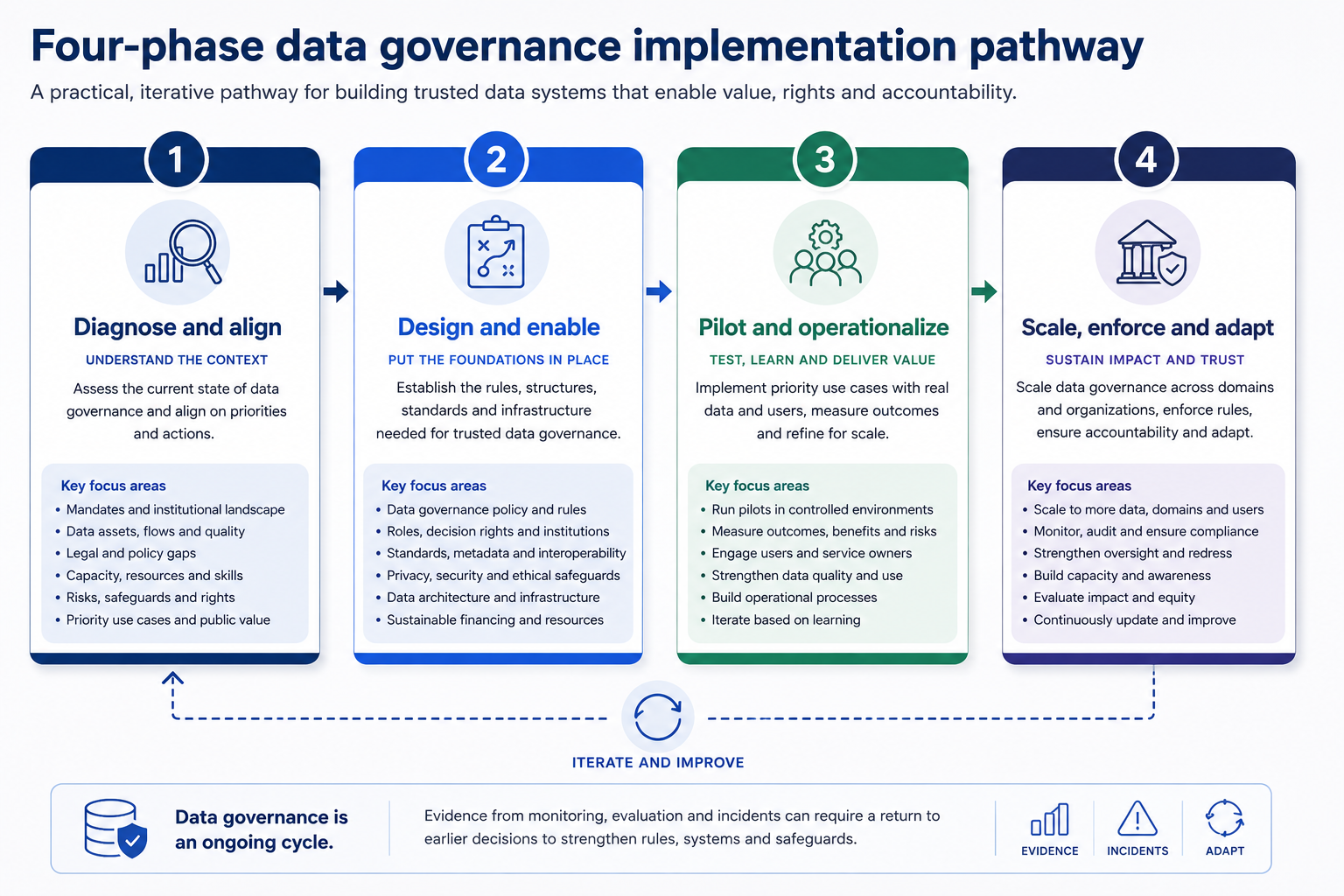
Source: Author’s analysis based on the implementation evidence discussed in this article.
Phase 1: Diagnose and align
Phase 1 begins with a realistic assessment of the country’s starting point. Government should map institutional mandates, key stakeholders, priority datasets, existing systems and exchanges, legal barriers, data-quality problems, cybersecurity arrangements, skills, and available financing. It should also identify public services where people or agencies repeatedly provide or verify the same information and examine the informal data-sharing practices that may already exist. A lead institution and an interim coordination mechanism should be confirmed early. The main output should be a costed implementation plan and a clear responsibility matrix that turns existing policy commitments into practical action.
The diagnosis should also examine the data needed for priority AI uses and determine whether those data are available and fit for purpose. An AI and data governance strategy may assume that health, agriculture, or education data are ready to use, even when the information is spread across different institutions, still kept on paper, restricted by law, or missing important groups. Identifying these problems early helps governments decide what needs to be fixed first, such as digitizing records, improving data quality, or strengthening the underlying public service before making major investments in AI.
The ITU Collaborative AI frameworks and preparedness diagnostic can serve as the main assessment instrument for this phase. Its six steps (defining objectives and scope, establishing a diagnostic governance team, collecting evidence, scoring indicators, identifying priority gaps and developing a roadmap) produce the mandate map, gap inventory and sequenced actions that Phase 1 requires. The diagnostic governance team, usually chaired by the digital ministry or national AI coordination body and including the ICT regulator, the data protection authority, competition and consumer agencies, the cybersecurity authority and relevant sector regulators, can also act as the interim coordination mechanism for data governance. Adding the national statistics office to that team would bring the quality and metadata perspective discussed in Section 3.4. Because the guide recommends repeating the diagnostic every two to three years, it can also provide the fresh diagnosis that Phases 3 and 4 may call for.
Phase 2: Design and enable
Phase 2 establishes the basic operating arrangements. These include implementing rules, institutional data functions, metadata and classification standards, model agreements, security requirements, quality procedures, financing arrangements, procurement rules, and processes for complaints and disputes. The architecture should reflect the services being developed and the maturity of existing government systems. Regulators should publish practical guidance, explain how supervision will work, and connect training to named roles and day-to-day responsibilities.
Safeguards, such as access controls, logging, correction of source records, retention rules, incident response, and human review, need to be considered during the design phase. The same applies to openness and public-interest access. Decisions about who may use data, for which purposes, under what conditions, and at what cost should be made as part of the architecture rather than added later.
Phase 3: Pilot and operationalize
Phase 3 tests a small number of services under real operating conditions. Before testing begins, one institution is named as the service owner and remains responsible for the service after the pilot. Testing covers connections between systems, data quality, processing times, security, accessibility and inclusion, errors, user support, incident response, audit, change management and the workload placed on participating institutions. High-impact AI applications also undergo an impact assessment and documented evaluation, with clear arrangements for human oversight and an accessible appeal process. Feedback is gathered from affected residents and the officials who operate the service. The pilot concludes with a recorded decision to expand, redesign or stop, and preserves any useful tools, standards and procedures for future work.
When legal or compliance questions remain unresolved, a regulatory sandbox offers a supervised setting for the pilot. Brazil’s National Data Protection Authority provides a current example. Its AI and data protection sandbox follows three participating companies through controlled monitoring cycles focused on governance, security, transparency, anonymization and the collection of evidence. Bringing the regulator into the testing process early helps resolve practical questions and allows the lessons to inform future guidance and oversight.[56]
Phase 4: Scale, enforce and adapt
The fourth phase expands arrangements that have shown clear value in practice. Recurring budgets, service management, audit, regulatory enforcement, and cross-border cooperation should become part of normal government operations. New institutions can then be onboarded against agreed minimum standards, with additional support for those starting from a weaker technical or institutional base. Governments should also track concentration risks, exclusion, dependence on particular suppliers, new uses of data, and unintended effects. Standards and guidance need regular review, and outdated systems or requirements should be retired when they no longer serve their purpose.
As the system matures, public reporting and independent evaluation become more important. Early programs may need to rely on proxy indicators. As evidence improves, governments should be able to show whether services are faster, fairer, and more reliable; whether errors are corrected in practice; whether smaller organizations can gain appropriate access; and whether AI systems rely on properly documented and monitored data.
Table 4. Illustrative indicators by implementation phase
|
Phase |
Institutional and regulatory |
Technical and operational |
Outcome and trust |
|
PHASE 1 Diagnose and align
|
Lead designated; mandate map and coordination mechanism completed |
Priority data, systems, legal and quality gaps inventoried |
Use cases selected with public-interest objectives and an initial risk classification |
|
PHASE 2 Design and enable
|
Rules, standards, financing, guidance and complaints process approved |
Metadata, classification, security, API and logging standards available |
Stakeholders consulted; capacity plan and baseline measures established |
|
PHASE 3 Pilot and operationalize
|
Service owner designated and regulatory oversight arrangements confirmed |
Services active; quality and security tests completed; incidents recorded |
Time, cost, errors, inclusion, user experience and access to redress evaluated |
|
PHASE 4 Scale, enforce and adapt
|
Recurring budgets, audits, enforcement and cross-border cooperation in place |
Additional institutions onboarded; standards updated; portability tested |
Public value, market access, AI performance, distributional effects and trust monitored |




Source: Author’s analysis based on the sources cited in the text.
Indicators should show whether data governance works in practice and creates value, rather than simply counting activity. High transaction volumes may look impressive even when source data are poor, and few complaints may reflect a redress process that people struggle to access. Training figures are equally difficult to interpret when staff lack clear responsibilities or the tools needed to apply what they have learned. A useful indicator set should combine institutional capacity, technical performance, and real-world outcomes, with measures evolving as the program matures.
|
Box 1: Linking implementation to the ITU collaborative AI frameworks and preparedness diagnostic The ITU guide on collaborative AI frameworks and preparedness diagnostic pairs two questions. A collaborative framework identifies which institutions need to work together to govern AI. A preparedness diagnostic assesses whether those institutions are ready to perform their roles. The diagnostic covers eight dimensions: vision and strategic alignment; governance and institutional preparedness; digital and computing infrastructure; data governance and data ecosystems; talent, skills and institutional capabilities; innovation, competition and procurement; ethics, trust and societal preparedness; and implementation, supervision and enforcement. Each dimension has seven indicators scored from 0 (not present) to 2 (fully present), giving a dimension score out of 14 and one of four maturity levels: nascent, emerging, established or advanced. This article and the diagnostic answer related questions. The diagnostic shows where a country stands and which gaps should be addressed first. This article shows how governments and regional organizations have addressed similar gaps in practice. A country can use the diagnostic to locate its gaps in data governance and then draw on the implementation approaches in Section 3 to decide how to close them. |
8. Conclusion
Data governance becomes real through everyday institutional practice. Laws, strategies, and digital platforms provide an important foundation, and implementation takes shape when institutions understand their responsibilities, people can find and understand the data they need, legitimate users have secure and predictable routes to access, and errors or misuse can be identified and corrected. Making this work requires a combination of clear rules, capable institutions, practical tools, infrastructure, sustainable financing, skilled staff, public participation, and effective oversight.
The country and regional cases reviewed here demonstrate several workable approaches to implementation. Regional organizations can develop common instruments and support cross-border cooperation. Central authorities can set direction and common standards, with source institutions remaining responsible for the data they create and maintain. Exchange platforms can reduce repeated verification and support more proactive public services. Regulators can turn legal duties into practical guidance and compliance processes, statistics offices can strengthen metadata and data quality, and sector-specific projects can give agencies a concrete reason to work together. The strongest systems combine several of these approaches within the same governance framework.
The right institutional model depends on national circumstances. Centralized arrangements need sufficient authority, resources, and independent safeguards. Distributed systems rely on reliable registers and institutions that maintain source data carefully. Voluntary guidance works best where organizations have the capacity to apply it and regulators can provide credible supervision. Regional rules depend on national institutions capable of carrying them out, and sectoral initiatives need common standards that allow data to move across institutional boundaries. Whatever institutional model is chosen, it needs recurring financing, public trust and evidence that it is producing real value.
For governments preparing for AI, the goal is responsible and useful access to data rather than simply greater volumes of collection and exchange. AI-ready data need to be lawful, relevant to the intended use, well documented, sufficiently representative, secure, interoperable, and subject to meaningful accountability. Starting with a manageable set of public-interest uses gives governments space to test what works, correct weaknesses, and build the institutions and practices needed for a trusted digital and AI ecosystem.
-
“Navigating Data Governance: A Guiding Tool for Regulators,” ITU- WB Digital Regulation Platform (2024), https://digitalregulation.org/navigating-data-governance-a-guiding-tool-for-regulators/. ↑
-
International Telecommunication Union, AI Ready: Analysis Towards a Standardized Readiness Framework, Report 2.0 (2025), https://www.itu.int/hub/publication/t-ai4g-ai4good-2025-6/. ↑
-
African Union, AU Data Policy Framework (2022), https://au.int/en/documents/20220728/au-data-policy-framework; ASEAN, ASEAN Data Management Framework (2021), https://asean.org/wp-content/uploads/2021/08/ASEAN-Data-Management-Framework.pdf; Organization of American States, Inter-American Framework on Data Governance and Artificial Intelligence (MIGDIA), https://www.oas.org/ext/en/democracy/inter-american-framework-on-data-governance-and-artificial-intelligence-migdia; European Commission, “European Data Governance Act,” https://digital-strategy.ec.europa.eu/en/policies/data-governance-act. ↑
-
Personal Data Protection Commission Singapore, “About PDPC” (2026), https://www.pdpc.gov.sg/about/about-pdpc; Personal Data Protection Commission Singapore, “Guide to Developing a Data Protection Management Programme” (2023), https://www.pdpc.gov.sg/organisations/resources/guidance-by-topic/guide-to-developing-a-data-protection-management-programme; Personal Data Protection Commission Singapore, “PDPA Assessment Tool for Organisations” (2022), https://www.pdpc.gov.sg/organisations/resources/guidance-by-topic/pdpa-assessment-tool-for-organisations; Personal Data Protection Commission Singapore, “Singapore’s Approach to AI Governance” (2023), https://www.pdpc.gov.sg/organisations/resources/guidance-by-topic/singapores-approach-to-ai-governance ↑
-
Nigeria Data Protection Commission, Nigeria Data Protection Act (NDP Act) 2023: General Application and Implementation Directive (GAID) 2025, NDPC/NDP ACT-GAID/01/2025 (20 March 2025), arts. 7–10 and 39–40, https://ndpc.gov.ng/wp-content/uploads/2025/07/NDP-ACT-GAID-2025-MARCH-20TH.pdf ↑
-
UNESCO, Recommendation on the Ethics of Artificial Intelligence (Paris, 2021), paras. 25-26, 29, 53-57 and 86-91, https://unesdoc.unesco.org/ark:/48223/pf0000381137; Artificial Intelligence Risk Management Framework (AI RMF 1.0), NIST AI 100-1 (Gaithersburg, 2023), https://doi.org/10.6028/NIST.AI.100-1. ↑
-
Council of Ministers of Saudi Arabia, Regulatory Arrangements of the Saudi Data and Artificial Intelligence Authority, https://sdaia.gov.sa/en/SDAIA/about/Documents/organizationalArrangements.pdf; Saudi Data and Artificial Intelligence Authority, “National Data Management Office,” https://sdaia.gov.sa/en/Sectors/NDMO/Pages/default.aspx; Saudi Data and Artificial Intelligence Authority, “National Information Center,” https://sdaia.gov.sa/en/Sectors/Nic/Pages/default.aspx. ↑
-
Saudi Data and Artificial Intelligence Authority, Data Sharing Policy, https://dgp.sdaia.gov.sa/wps/portal/pdp/knowledgecenter/details/DataSharingPolicy1/!ut/p/z1/04_Sj9CPykssy0xPLMnMz0vMAfIjo8ziPR1dzTwMgw2MDMOcTA3MjH39TE29jY0MQsz1w9EUhIZZAhUEGvl6OXoaGwQY60cRo98AB3A0IKTfi5ACoA-MinydfdP1owoSSzJ0M_PS8vUjXBJLEoMzEosy89ID8nMykysNgS6JwmuWhTGGAkzPghXg8U1wYpF-QW5oRJVPWrCnrqMiAKEmPUE!/dz/d5/L0lHSkovd0RNQU5rQUVnQSEhLzROVkUvZW4!/; Saudi Data and Artificial Intelligence Authority, Data Management and Personal Data Protection Standards, https://sdaia.gov.sa/ndmo/Files/PoliciesEn001.pdf. ↑
-
Saudi Data and Artificial Intelligence Authority, “Government Service Bus,” https://sdaia.gov.sa/en/Services/Pages/GSB.aspx; “Data Marketplace Platform,” https://sdaia.gov.sa/en/Services/Pages/DataMarketplace.aspx; “National Data Governance Platform,” https://dgp.sdaia.gov.sa/wps/portal/pdp/home/. ↑
-
Rwanda Information Society Authority, “National Data Sharing Policy Approved,” 27 May 2025, https://www.risa.gov.rw/news-detail/national-data-sharing-policy-approved; Ministry of ICT and Innovation, Government of Rwanda, National Data Sharing Policy (2025), https://www.minict.gov.rw/index.php?eID=dumpFile&f=130290&t=f&token=2f207763665aa480e65386c025175bf4330b9a5c. ↑
-
National Institute of Statistics of Rwanda, “Data Governance,” including the National Data Governance Framework and supporting guidelines (2025), https://statistics.gov.rw/documents/strategies-and-policies/data-governance; Ministry of ICT and Innovation, The Five Safes Data Sharing Assessment Framework, Annex 5 to the National Data Sharing Policy (2025), https://www.minict.gov.rw/fileadmin/user_upload/minict_user_upload/Documents/Policies/The_National_Data_Sharing_Policy_Annexes/Annex_5_-_The_Five_Safes_Data_Sharing_Framework.pdf. ↑
-
Rwanda Information Society Authority, procurement for implementation of the Shared Government Data Hub and Data Interoperability Platform, Rwanda Digital Acceleration Project (2026), https://www.risa.gov.rw/publications/tenders. ↑
-
Ministry of Digital, Malaysia, “Data Sharing Act 2025 Comes Into Effect Today; Set to Enhance Government Services, Protect Personal Data,” 28 April 2025, https://www.digital.gov.my/en-GB/siaran/Akta-Perkongsian-Data-2025-Berkuat-Kuasa-Hari-Ini%3BTingkatkan-Perkhidmatan-Kerajaan%2CLindungi-Data-Peribadi; Ministry of Digital, Data Sharing Act 2025 (Act 864), https://www.digital.gov.my/en-GB/dasar. ↑
-
Malaysian Government Central Data Exchange, “About MyGDX,” https://www.mygdx.gov.my/en/landing-page/about?theme=second-theme; “Architecture MyGDX 2.0,” https://www.mygdx.gov.my/en/landing-page/architecture?theme=second-theme. ↑
-
Ministry of Digital, Malaysia, “Driving PPDSA Reforms through D.A.T.A.,” 6 February 2026, https://www.digital.gov.my/en-GB/siaran/Tema-%27D.A.T.A%27-Pemacu-Reformasi-PPDSA%3A-Kementerian-Digital-Tekad-Noktahkan-Birokrasi-Manual-Demi-Kesejahteraan-Rakyat-Malaysia. ↑
-
Secretariat for Digital Government, Ministry of Management and Innovation in Public Services, “Conecta GOV.BR,” https://www.gov.br/governodigital/pt-br/infraestrutura-nacional-de-dados/interoperabilidade/conecta-gov.br. ↑
-
Government of Brazil, “Mais de 1,1 bilhão de transações de dados foram realizadas no Conecta GOV.BR em 2025,” 9 January 2026, https://www.gov.br/gestao/pt-br/assuntos/noticias/2026/janeiro/mais-de-1-1-bilhao-de-transacoes-de-dados-foram-realizadas-no-conecta-gov-br-em-2025; G20 and OECD, Compendium on Data Access and Sharing Across the Public Sector and with the Private Sector for Public Interest (2024), https://www.gov.br/mcom/pt-br/acesso-a-informacao/governanca/governanca-de-tic-1/documentos-g20/p2-g20-dewg-brasil-2024-compendium-on-data-access-and-sharing.pdf/%40%40download/file. ↑
-
Government of Brazil, “Gestão lança soluções para a Infraestrutura Nacional de Dados durante a Semana da Inovação 2025,” 1 October 2025, https://www.gov.br/servidor/pt-br/assuntos/noticias/2025/outubro/gestao-lanca-solucoes-para-a-infraestrutura-nacional-de-dados-durante-a-semana-da-inovacao-2025. ↑
-
Estonian Information System Authority, “Data Exchange Layer X-tee,” https://www.ria.ee/en/state-information-system/data-exchange-platforms/data-exchange-layer-x-tee; Nordic Institute for Interoperability Solutions, X-Road Security Architecture, https://docs.x-road.global/Architecture/arc-sec_x_road_security_architecture.html. ↑
-
Republic of Estonia, Public Information Act, consolidated text, https://www.riigiteataja.ee/en/akt/525032026001; Estonian Information System Authority, “Estonian Data Portal,” https://www.ria.ee/en/state-information-system/data-based-governance-and-reuse-data/estonian-data-portal. ↑
-
Estonian Information System Authority, “Single Digital Gateway and the European Union Once-Only Technical System,” https://www.ria.ee/en/state-information-system/data-exchange-platforms/single-digital-gateway-european-union-sdg. ↑
-
Smart Data Ukimet, official platform, https://sdu.gov.kz/; Government of Kazakhstan, “Kazakhstan Joins the 50-in-5 Campaign,” 25 June 2025, https://oq.gov.kz/en/qazalemnews/1047. ↑
-
Ministry of Labour and Social Protection of the Population of Kazakhstan, “Digital Family Card Launched in Kazakhstan,” 2023, https://www.gov.kz/memleket/entities/enbek/press/news/details/485349?lang=ru; International Telecommunication Union, “Kazakhstan’s Digital Family Card: Ensuring Equal Access to Social Protection,” 2023, https://www.itu.int/hub/2023/09/kazakhstans-digital-family-card-ensuring-equal-access-to-social-protection/; Government of Kazakhstan, “Kazakhstan Showcases Digital Future at UN Conference in Avaza,” 2025, https://oq.gov.kz/en/qazalemnews/1132. ↑
-
Republic of Kazakhstan, Law on Artificial Intelligence, Law No. 230-VIII of 17 November 2025, https://adilet.zan.kz/eng/docs/Z2500000230; Republic of Kazakhstan, Digital Code, Code No. 255-VIII of 9 January 2026, https://www.adilet.zan.kz/eng/docs/K2600000255; OECD, OECD Public Governance Scan of Kazakhstan: Toward a More Agile, Responsive and Effective Public Administration (2025), https://www.oecd.org/content/dam/oecd/en/publications/reports/2025/05/oecd-public-governance-scan-of-kazakhstan_9fe50ba2/f8298798-en.pdf. ↑
-
Personal Data Protection Commission, Singapore, Model Artificial Intelligence Governance Framework, second edition (2020), https://www.pdpc.gov.sg/-/media/Files/PDPC/PDF-Files/Resource-for-Organisation/AI/SGModelAIGovFramework2.pdf; Personal Data Protection Commission, “Singapore’s Approach to AI Governance,” https://www.pdpc.gov.sg/organisations/resources/guidance-by-topic/singapores-approach-to-ai-governance. ↑
-
Personal Data Protection Commission, Singapore, Advisory Guidelines on Use of Personal Data in AI Recommendation and Decision Systems, 1 March 2024, https://www.pdpc.gov.sg/organisations/regulations-decisions/regulatory-guidance/advisory-guidelines-on-use-of-personal-data-in-ai-recommendation-and-decision-systems. ↑
-
AI Verify Foundation, “AI Verify,” https://aiverifyfoundation.sg/; OECD.AI Policy Observatory, “AI Governance Testing Framework and Toolkit – AI Verify,” https://oecd.ai/en/wonk/ai-verify. ↑
-
Nigeria Data Protection Commission, Nigeria Data Protection Act General Application and Implementation Directive (GAID) 2025, 20 March 2025, https://ndpc.gov.ng/wp-content/uploads/2025/07/NDP-ACT-GAID-2025-MARCH-20TH.pdf. ↑
-
Nigeria Data Protection Commission, Guidance Notice on the Registration of Data Controllers and Processors of Major Importance (2024), https://ndpc.gov.ng/wp-content/uploads/2025/07/Updated-Guidance-Notice-on-Registtration-2024.pdf; Nigeria Data Protection Commission, “Frequently Asked Questions,” https://ndpc.gov.ng/faqs/; Nigeria Data Protection Commission, “DPCO Registration and Requirements,” https://ndpc.gov.ng/dpco-registration-requirements/. ↑
-
Nigeria Data Protection Commission, “NDPC Engages Finance, Telecoms, and Hospitality Sectors to Develop Tailored Data Privacy Frameworks,” 18 June 2026, https://ndpc.gov.ng/ndpc-engages-finance-telecoms-and-hospitality-sectors-to-develop-tailored-data-privacy-frameworks/. ↑
-
Czech Telecommunications Office, “CTU Will Newly Oversee the Digital Economy,” 16 August 2023, https://ctu.gov.cz/en/press-release-ctu-will-newly-oversee-digital-economy. ↑
-
European Commission, “National Competent Bodies and Authorities under the Data Governance Act,” https://digital-strategy.ec.europa.eu/en/library/national-competent-bodies-and-authorities-under-data-governance-act. ↑
-
Brazilian National Data Protection Authority, “International Affairs and International Data Transfers,” https://www.gov.br/anpd/pt-br/assuntos/assuntos-internacionais/transferencia-internacional-de-dados/international-affairs. ↑
-
Republic of Colombia, Law 2335 of 2023 on Official Statistics, 3 October 2023, https://www.dane.gov.co/files/acerca/Normatividad/leyes/Ley2335de2023-IN.pdf; National Administrative Department of Statistics, “Law on Official Statistics of Colombia,” https://www.dane.gov.co/index.php/acerca-del-dane/informacion-institucional/normatividad/leyes/ley-de-estadisticas-oficiales-de-colombia. ↑
-
National Administrative Department of Statistics, Colombia, “La presentación de la Estrategia País IDEC expuso los aportes de la infraestructura de datos para la toma de decisiones,” 19 March 2024, https://www.dane.gov.co/index.php/actualidad-dane/5735-la-presentacion-de-la-estrategia-pais-idec-expuso-los-aportes-de-la-infraestructura-de-datos-para-la-toma-de-decisiones. ↑
-
National Institute of Statistics of Rwanda, “Data Governance,” https://statistics.gov.rw/documents/strategies-and-policies/data-governance; National Institute of Statistics of Rwanda, National Metadata Management Guideline (2025), https://www.alpha.statistics.gov.rw/sites/default/files/documents/2025-10/National_Metadata_Management_Guideline.pdf. ↑
-
Statistics South Africa, “Standardisation,” including the South African Statistical Quality Assessment Framework and operational standards, https://www.statssa.gov.za/?page_id=371; Statistics South Africa, South African Statistical Quality Assessment Framework, edition 2, https://beta2.statssa.gov.za/standardisation/SASQAF_Edition_2.pdf. ↑
-
Department of Communications and Digital Technologies, South Africa, Final National Data and Cloud Policy, Government Gazette No. 50741 (2024), https://www.dcdt.gov.za/documents/legislations/policies/file/335-government-gazette-no-50741-electronic-communications-act-36-2005-publication-of-the-final-national-data-and-cloud-policy.html. ↑
-
European Commission, “Common European Data Spaces,” https://digital-strategy.ec.europa.eu/en/policies/data-spaces; Data Spaces Support Centre, https://dssc.eu/. ↑
-
African Union, AU Data Policy Framework (2022), https://au.int/en/documents/20220728/au-data-policy-framework. ↑
-
African Union, “AU Commences Validation of Data Governance Frameworks to Accelerate the Digital Single Market,” 2 December 2025, https://au.int/en/pressreleases/20251202/validation-data-governance-frameworks-accelerate-digital-single-market. ↑
-
ASEAN, Framework on Digital Data Governance (2018), https://asean.org/wp-content/uploads/2012/05/6B-ASEAN-Framework-on-Digital-Data-Governance_Endorsedv1.pdf; ASEAN, ASEAN Data Management Framework (2021), https://asean.org/wp-content/uploads/2021/08/ASEAN-Data-Management-Framework.pdf; ASEAN, ASEAN Model Contractual Clauses for Cross-Border Data Flows (2021), https://asean.org/wp-content/uploads/3-ASEAN-Model-Contractual-Clauses-for-Cross-Border-Data-Flows_Final.pdf. ↑
-
Organization of American States, Inter-American Framework on Data Governance and Artificial Intelligence (MIGDIA), active since 2023, https://www.oas.org/ext/en/democracy/inter-american-framework-on-data-governance-and-artificial-intelligence-migdia; Organization of American States, Inter-American Guidelines on Data Governance and Artificial Intelligence (November 2024), https://www.oas.org/ext/en/democracy/inter-american-framework-on-data-governance-and-artificial-intelligence-migdia/moduleid/14733/id/1080/lang/1/controller/item/action/download. ↑
-
Organization of American States, “Results: Inter-American Framework on Data Governance and Artificial Intelligence,” https://www.oas.org/ext/en/democracy/results/program/264. ↑
-
European Parliament and Council of the European Union, Regulation (EU) 2022/868 on European data governance (Data Governance Act), https://eur-lex.europa.eu/eli/reg/2022/868/oj/eng; Regulation (EU) 2023/2854 on harmonised rules on fair access to and use of data (Data Act), https://eur-lex.europa.eu/eli/reg/2023/2854/oj/eng; Directive (EU) 2019/1024 on open data and the reuse of public-sector information, https://eur-lex.europa.eu/eli/dir/2019/1024/oj/eng. ↑
-
European Commission, “Common European Data Spaces,” https://digital-strategy.ec.europa.eu/en/policies/data-spaces. ↑
-
European Commission, “Commission Calls on 18 Member States to Comply with the EU Data Governance Act,” 23 May 2024, https://digital-strategy.ec.europa.eu/en/news/commission-calls-18-member-states-comply-eu-data-governance-act. ↑
-
Otandastar Qory, “A Large Language Model KazLLM Has Been Developed,” https://oq.gov.kz/en/qazalemnews/52; Commission nationale de l’informatique et des libertés (CNIL), “Ensuring and Facilitating the Exercise of Data Subjects’ Rights,” 5 January 2026, https://www.cnil.fr/en/ensuring-and-facilitating-exercise-data-subjects-rights; Information Commissioner’s Office, Response to the UK Government’s Consultation on Copyright and Artificial Intelligence, paras. 15–16 and 22–23, https://ico.org.uk/media2/p3mkalna/our-response-to-uk-governments-consultation-on-copyright-and-artificial-intelligence.pdf. ↑
-
ProZorro, “About Prozorro,” Government of Ukraine, https://prozorro.gov.ua/en/about; ProZorro, “Open Data and Developers,” Government of Ukraine, https://prozorro.gov.ua/openprocurement. ↑
-
“Navigating Data Governance: A Guiding Tool for Regulators” (2024), ITU-WB Digital regulation platform https://digitalregulation.org/navigating-data-governance-a-guiding-tool-for-regulators/; International Telecommunication Union, Global Digital Regulatory Outlook 2023, https://digitalregulation.org/wp-content/uploads/D-PREF-BB.REG_OUT01-2023-PDF-E.pdf. ↑
-
Dan Jerker B. Svantesson, “Data Localisation Trends and Challenges: Considerations for the Review of the Privacy Guidelines,” OECD Digital Economy Papers, No. 301 (Paris: OECD Publishing, 2020), https://doi.org/10.1787/7fbaed62-en. ↑
-
World Bank, World Development Report 2021: Data for Better Lives (Washington, DC: World Bank, 2021), especially chapters 5 to 9 and the discussion of cross-border data flows and localization, https://wdr2021.worldbank.org/. ↑
-
Regulation (EU) 2023/2854 of the European Parliament and of the Council of 13 December 2023 on harmonised rules on fair access to and use of data (Data Act), especially arts. 23 to 31 on switching between data-processing services and art. 32 on international governmental access and transfer, https://eur-lex.europa.eu/eli/reg/2023/2854/oj. ↑
-
European Commission, “Rules on International Data Transfers,” outlining adequacy decisions, standard contractual clauses, binding corporate rules, certification mechanisms, codes of conduct, and derogations under the GDPR, https://commission.europa.eu/law/law-topic/data-protection/international-dimension-data-protection/rules-international-data-transfers_en; European Data Protection Board, Recommendations 01/2020 on Measures that Supplement Transfer Tools to Ensure Compliance with the EU Level of Protection of Personal Data, final version adopted 18 June 2021, https://www.edpb.europa.eu/documents/recommendation/recommendations-012020-on-measures-that-supplement-transfer-tools-to_en. ↑
-
Regulation (EU) 2025/327 of the European Parliament and of the Council of 11 February 2025 on the European Health Data Space; European Commission, “European Health Data Space Regulation,” including requirements for secure processing environments for secondary use of health data, https://health.ec.europa.eu/ehealth-digital-health-and-care/european-health-data-space-regulation-ehds_en. ↑
-
Agência Nacional de Proteção de Dados, “Publicados primeiros resultados do Sandbox Regulatório em Inteligência Artificial,” 2 July 2026, https://www.gov.br/anpd/pt-br/assuntos/noticias/publicados-primeiros-resultados-do-sandbox-regulatorio-em-inteligencia-artificial. ↑