Access for All: UMC and efforts to promote access and affordability
01.09.2025Introduction
Broadband Internet access continues to cement its place as a fundamental necessity to communities across the world, making it increasingly important to ensure the promise of universal service. Without affordable Internet access, individuals and communities experience increased socioeconomic challenges and reduced opportunities for education and employment. Further, as government agencies and other public services continue to rely on the Internet to perform basic administrative functions, it is essential that all citizens have access to the digital world.
This section explores the importance of expanding broadband access and affordability to meet global and national connectivity goals. It also introduces several examples of policy mechanisms to prioritize broadband deployment, enshrine connectivity rights, subsidize costs, and leverage new technology to end the digital divide.
Universal and Meaningful Connectivity
In 2021, the ITU and the United Nations Office of the Secretary-General’s Envoy on Technology (UN Tech Envoy) established a series of targets to achieve universal and meaningful connectivity (UMC) by 2030. UMC is defined as enabling everyone to enjoy a safe, enriching, and productive online experience at an affordable cost. UMC does not mean everyone must be connected all the time but describes a situation where everyone can access the Internet optimally and affordably whenever and wherever needed.
The benefits of UMC can be illustrated within 10 contexts:
- Digital inclusion: ensuring that no one is left behind as the world continues to advance.
- Government and financial operations: providing access for all to utilize digital government and financial services.
- Crisis response and emergencies: making emergency services more accessible through broadband.
- Cross-cultural interactions: bringing people together across borders to share customs and cultural experiences.
- Sustainable cities: enabling smart city technologies to improve quality of life for residents.
- Digital economy and workplace: providing new opportunities for businesses and workers to thrive.
- Health and public services: enabling rural health care providers and telehealth.
- Equality: expanding opportunity to people regardless of race, gender, or geographic location.
- Innovation and entrepreneurship: creating opportunities to drive innovation and sustainable development.
- Education: bringing learning outside the classroom and expanding opportunities to students without access to traditional education.
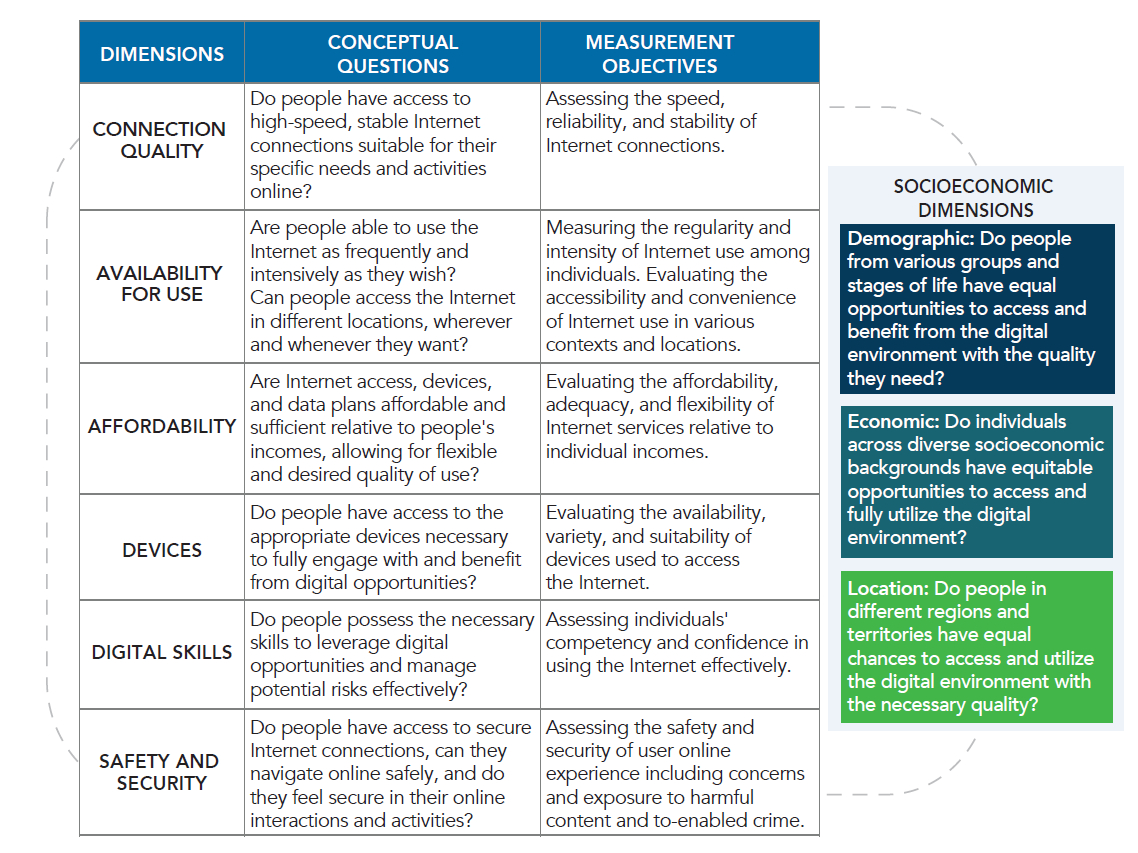
UMC is not just about delivering connectivity for all – it is also about providing a level of connectivity and related skills and capabilities that enable Internet users to have a safe, productive, affordable, and empowering experience online. In conjunction with the ITU in 2024 G20 proposed a measurement framework that provides insight into the various factors that comprise UMC.
Figure 1. Proposed framework for measuring UMC
Source: G20.
As illustrated in Figure 1, meaningful connectivity provides additional dimensions on which to evaluate benefits related to infrastructure, affordability, devices, skills, and security/safety. This makes it essential to focus on efforts to increase access, affordable broadband for all.
Access
Broadband access is a foundational enabling factor to promoting UMC across the world. Without robust, high-quality networks, populations around the world are unable to benefit from Internet access. This section addresses key policy actions and considerations to ensure that universal broadband access to digital services is advanced through development strategies, new technologies, and infrastructure sharing.
Broadband as a universal right
The concept of enshrining broadband as a universal right has been explored at both the global and national level. In 2016, the UN modified Article 19 of the Universal Declaration of Human Rights to call on states to “consider formulating, through transparent and inclusive processes with all stakeholders, and adopting national Internet-related public policies that have the objective of universal access and enjoyment of human rights at their core” (UN 2016). Further, in October 2024, the UN Human Rights Council passed resolution A/HRC/57/L.28 on the promotion, protection, and enjoyment of human rights on the Internet. The resolution calls on states to (1) speed up efforts to bridge the digital divide, and (2) promote free, open, interoperable, reliable, accessible, and secure access to the Internet (UN 2024).
Similarly, there have been numerous efforts at the national level to provide fundamental rights of Internet access to citizens. These measures vary in format, structure, and jurisdiction, showcasing the different levers that countries can use to make Internet access a right for all.
Broadband in national digital development plans
Broadband is also a fixture in national-development plans, which are strategies to address the needs of citizens, solve pressing national policy priorities, and chart a course for future growth. These development plans are often established with a specific end date, creating whole-of-government efforts that incorporate multiple stakeholders to address urgent challenges such as poverty, economic growth, and education. These plans provide the foundation upon which more-focused digital development plans are built.
For example, Visión 2050 Colombia, developed by the Colombian Centre for Sustainable Development (CECODES), provides a nine-part roadmap for sustainable short-, medium-, and long-term growth within the country. With regard to connectivity, the report calls on business leaders to collaborate with the government, private sector, financial institutions, and other stakeholders to provide infrastructure and services in order to guarantee affordable and reliable connectivity for all rural and urban areas of Colombia (CECODES 2023). Visión 2050 informed Colombia’s current National Digital Strategy, which includes Internet connectivity and access among eight strategies intended to meet the objective of unleashing digital transformation across the country (MinTIC 2024a). Also in 2024, the government described a connectivity plan that addresses six pillars: the backbone network, mobile access networks, fixed access networks, educational institution connectivity, affordability and ownership, and institutional development (MinTIC 2024b).
Similarly, the Government of Rwanda’s Vision 2050 provides a long-term vision for sustained growth and recognises the importance of the ICT sector in driving economic growth and social development. In the section focused on goals related to urbanization and agglomeration, the document states that by 2050, “broadband coverage will be provided to all citizens through the continuous roll-out of latest technologies, promoting Internet of things and increase in smart devices penetration and usage enabled by modern household lifestyle” (Government of Rwanda 2020). These goals flow through to Rwanda’s most recent ICT Sector Strategic Plan (SSP), which includes the promotion of digital inclusion among its three strategic focus areas (Ministry of ICT and Innovation 2025). The SSP notes a commitment to increasing access and affordability, as well as promoting universal smart device ownership and closing the digital gender gap.
National digital development plans and digital transformation policies, including goals addressing broadband and connectivity, are high-level documents that often present long-term objectives. Such plans may be accompanied or supplemented by implementation plans or short- or medium-term plans that provide more detailed approaches by which the goals are to be achieved. For example, Kenya’s Vision 2030 plan has been implemented through successive five-year Medium Term Plans. The current Medium Term Plan addresses the 2023-2027 period and includes a broadband access objective including connecting nearly 2,300 public institutions (Republic of Kenya 2024). In addition, the Kenya National Digital Master Plan focuses more specifically on the ICT sector, including addressing universal access to ICT services (Ministry of ICT, Innovation, and Youth Affairs 2022). The Master Plan’s universal access identifies key outcomes focused on increased and enhanced connectivity and the availability of affordable digital infrastructure. While the implementation mechanism may vary across countries, meeting broadband access and affordability goals depends on establishing, pursuing, and monitoring progress toward specific measurable milestones.
As shown in these examples, national digital strategies or transformation plans frequently include universal access objectives and components. Such plans represent more focused approaches to meeting goals included in national development plans including connectivity and expanded access over the coming decades. By bringing together stakeholders across government, industry, and civil society, countries can leverage the momentum and prominence of long-term strategic visions and the focused objectives of digital transformation plans to ensure that broadband access for all is part of national plans for growth and prosperity.
UASF policies and funds
As detailed in [Access for All], universal access and service funds (UASFs) are funding mechanisms established by national governments to promote universal access to telecommunication services and bridge the digital divide. They provide financial incentives or support for telecommunication service operators to provide service in locations that would not be commercially viable otherwise (UN ESCAP 2017, 10). Traditionally, governments allocated service-specific subsidies (e.g., for fixed telephony payphone services). However, more countries have shifted to allow service-neutral competition (e.g., fixed or mobile), as well as technology-neutral competition for UASF subsidies.
UASFs are one method of subsidising network deployment. Rather than introducing tariffs or providing grants directly to consumers, these subsidies make it more enticing for operators to build out new networks and serve a broader range of customers. Further, as noted by, for example, the Economic Commission for Latin America and the Caribbean (ECLAC), UASFs can be used to fund programmes to assist people with disabilities (PWDs) (Bleeker 2019), a view that is equally valid for other disadvantaged populations. As such, UASFs should be updated or established to direct funds to (1) bring affordable broadband to underserved areas and population groups, and (2) support adoption and use.
Adoption and inclusion are further discussed in Access for All and Policies to Promote Inclusion.
Additional information on UASFs is presented in Financing universal access to digital technologies and services and the Universal Service Financing Efficiency Toolkit.
New technologies to promote access to connectivity
In the past several years, there have been multiple advances in connectivity technology that offer the potential to increase broadband access worldwide. One of these technologies is presented by new non-geostationary orbit (NGSO) low earth orbit (LEO) satellite constellations, which provide higher-speed, higher-capacity broadband connectivity than previous satellite technologies. These satellite technologies can help connect the unconnected, particularly in areas that lack high-quality mobile network coverage. Satellite broadband services, such as SpaceX’s Starlink and soon-to-be operational services like Amazon’s Project Kuiper and OneWeb, use NGSO constellations to provide Internet access through user terminals that were originally placed on homes or other structures (WEF 2022). Further developments have enabled the provision of NGSO satellite connectivity to vehicles and other non-stationary locations. Satellite operators continue to develop networks and services that seek to provide connectivity to a range of devices and populations.
Lastly, advances in fibre-to-the-premises (FTTP) services offer a terrestrial solution to improving broadband access. These services deliver high-speed Internet directly to homes, businesses, anchor institutions, and other locations via fibre optic cables and can offer significantly faster download and upload speeds compared to traditional broadband. While the initial cost of FTTP builds can be more expensive than other solutions, they are another way to offer fast, reliable Internet and advance a country’s connectivity goals. Many countries – such as Nigeria – have included the expansion of FTTP services in their national broadband plans, and policymakers should consider it as a tool to advance UMC targets domestically (Federal Ministry of Communications and Digital Economy 2020).
Infrastructure sharing
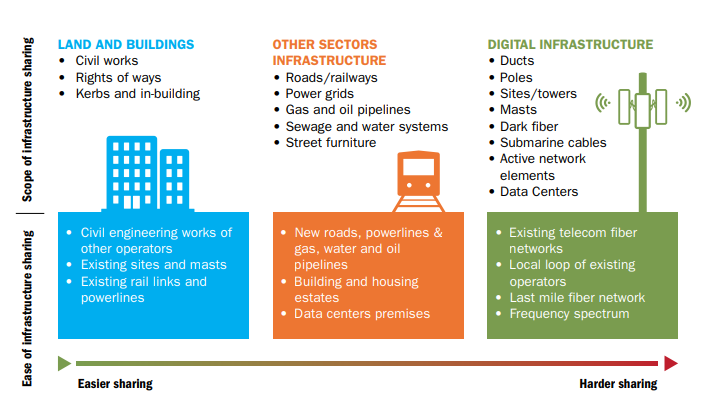
Telecommunications infrastructure sharing is another pathway to expand broadband access and meet UMC goals. Shared infrastructure can reduce the cost of broadband transmission and core network deployment by enabling operators to leverage existing infrastructure such as power transmission grids, roads, and towers (IFC 2020, ITU 2022). In particular, such sharing approaches can include shared access to rights-of-way, poles, and conduits. However, cross-sector infrastructure sharing can also take the form of utility providers leasing excess capacity on their internal fibre networks (i.e., unused or “dark” fibre) to enable commercial broadband provision. Such sharing depends on multiple factors, including an enabling regulatory environment, stakeholder cooperation, and complementary infrastructure. Infrastructure sharing can be incorporated into the planning stages of new neighbourhoods or cities – such as planning common conduits or trenches for water, electricity, and broadband services – and can also be facilitated by way of existing infrastructure that can be leveraged to avoid or minimise the need for new deployments.
Figure 3. Key opportunities for infrastructure sharing
Source: IFC; Deloitte; Association for Progressive Communication.
As shown in Figure 3, there are several components of network infrastructure that can be shared to reduce capital expenditure for network operators and digital infrastructure providers. Mobile broadband networks can utilize sharing mechanisms to reduce costs related to land, towers, and base stations, and fixed broadband networks can reduce expenditures by relying on shared ducts and poles for last-mile deployment. These cost savings can encourage operators to enter low-income and un/underdeveloped markets and further advance access-related connectivity goals.
Affordability
In addition to access, affordability is a key component to ensuring connectivity access for all. In over half of the economies for which data could be obtained, the fixed broadband target set by the Broadband Commission has not yet been met. Prices remain prohibitive in many parts of the world. In 2024, for the data-only mobile-broadband basket, 138 of the 208 economies for which ITU collects data met this target, one third did not (ITU2025). As many regions of the world are struggling to deliver affordable broadband to citizens. This section addresses various mechanisms to solve problems related to low purchasing power of consumers, high costs of network deployment, and prohibitive prices for end-user devices.
Subsidised access costs and price caps
Subsidising broadband costs and limiting service pricing are two methods of reducing the price of connectivity for consumers and further promote UMC-related goals, though they include inherent challenges. Broadband subsidisation can come in the form of end-user subsidies, price controls, payment plans, and sponsored data plans, enabling low-income or disadvantaged users to reap the benefits of broadband without worrying about cost.
The availability of service subsidies vary depending on the specific context in individual countries, including timing and other socioeconomic factors. Some countries have service subsidies that are offered voluntarily by operators. In the United Kingdom, several providers offer “social broadband tariffs” — or high-speed broadband packages at a reduced price – for certain customers. In order to be eligible for the tariff, customers must receive existing benefits through a collection of other nationwide social welfare programs (Ofcom 2025). Notably, the tariff is not reimbursed by the UK government, as telecommunications regulator Ofcom utilizes a combination of regulatory pressure and voluntary participation from industry to facilitate reduced rates.
Regulatory action to limit service costs can also benefit consumers, although it is important that stakeholders consider the costs of service delivery and sustainability in establishing such rates. In 2022, the Bangladesh Telecommunication Regulatory Commission (BTRC) launched its “One Country, One Rate” program following extensive stakeholder consultation and analysis, notably including stakeholders at multiple points in the broadband value chain. The program was founded with the objective of providing affordable fixed Internet for all and introduces a tariff to ensure that broadband prices are universally affordable in both urban and rural areas, with prices as illustrated in Table 1 (BTRC 2022).
Table 1. Bangladesh One Country, One Rate pricing
| Bandwidth (Minimum) | ISP Tariff, USD/Month |
| 5 Mbps | 4.18 |
| 10 Mbps | 6.68 |
| 20 Mbps | 10.02 |
Source: BTRC
This program is anticipated to benefit both consumers and operators, as consumers receive affordable Internet with uniform nationwide quality-of-service standards and operators are projected to receive additional revenue from the uptick in customers, particularly in rural areas. Importantly, the price set by BTRC was based on extensive consultation with Internet service provision stakeholders and acceptance of the proposed tariff by the stakeholders.
Subsidization of access costs and limits on service pricing are tools that may be available to regulators and policymakers to increase broadband affordability. However, these are dependent upon factors including service delivery cost structures, available subsidy funding, and service provider cooperation. The latter point, in particular, highlights the importance of collaboration between regulators and operators to address broadband accessibility goals.
Managing service costs through competition
Competition is one of the key drivers of broadband affordability and leads to lower prices, faster Internet speeds, broader deployment, increased innovation, and improved customer service (ITIF 2007). But in many markets, there are a limited number of broadband providers offering service to customers due to high costs associated with building new networks, regulatory hurdles, and the existence of incumbent providers with significant market share. As such, governments should focus on maximising competition, including removing regulatory barriers to entry and creating incentives for private investment (Broadband Commission 2022, 52).
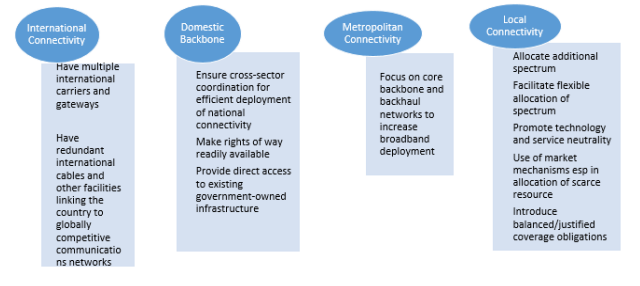
In Kenya’s 2018-2023 National Broadband Strategy, promoting competition was listed as one of the key mitigation strategies to addressing the slow uptake of broadband services (Republic of Kenya 2018). Further, the strategy identifies several competition-related actions to improve the government’s legal, policy, and regulatory ICT regime:
- Licensing and authorisation: open rights of way and access to facilities to help promote sharing of passive infrastructure and promote competition.
- Spectrum management: ensure an abundant supply of spectrum to reduce barriers to entry for service providers and increase innovation.
- Growth of existing infrastructure: provide incentives for private sector investment, promote infrastructure sharing through joint ventures, and conduct market studies to ensure market efficiency.
Kenya’s efforts to promote competition in the ICT sector are further illustrated in Figure 4.
Figure 4. Pro-competition measures in Kenya
Source: Government of Kenya
However, the Government of Kenya has not yet published a follow-on plan or evaluation of the impact of the National Broadband Strategy. In the meantime, however, the Communications Authority of Kenya adopted the Strategic Plan 2023-2027, which addresses some of the same issues. To further promote competition, the strategic plan identifies the “fostering of competitive ICT markets and emerging technologies” as a strategic goal and lists achieving improved service quality, affordable pricing, additional service options, and increased investments into research and development as goals to help foster a competitive ICT market (Communications Authority of Kenya 2023).
Altogether, Kenya’s 2018-2023 National Broadband Strategy – and the Strategic Plan 2023-2027 – showcase the important role of promoting competition to address broadband affordability. It is important to prioritise competition across different pillars of the broadband ecosystem – including spectrum, infrastructure, and licensing frameworks – to create a robust marketplace that offers consumers a choice of providers with competitive prices.
Addressing device cost
As discussed in [Access for All], targeted policies, subsidies, and payment plans are often used to improve the affordability of digital services and end-user devices for vulnerable populations. For example, national policies can be leveraged to foster local innovation and research and development for Internet-enabled devices such as handsets, as well as prioritize support through government investment agencies for ventures (between local and foreign firms or public-private partnerships, or PPPs) that seek to offer low-cost devices to the market (Broadband Commission for Sustainable Development 2019). An example of this is seen in India, where the India Production Linked Incentive scheme works to incentivise the local manufacturing of mobile phones. The program helped Reliance Jio locally produce one of its handsets, which has resulted in lower production costs that are passed on to the consumer in the form of lower device costs (GSMA 2022).
Government entities can explore alternative approaches to lessen the cost of handsets and bring connectivity to new segments of the population. These can include, for example, tax policies that reduce device costs for users. For example, the South African government’s 2025 budget proposal includes a plan to eliminate the value-added tax on smartphones with a cost below ZAR 2,500 (USD 140) as a means to promote digital inclusion among low-income households (National Treasury 2025). Additionally, policymakers can also leverage the private sector and NGOs to reduce device costs. In Pakistan, Mobilink Microfinance Bank has incorporated a smartphone financing option into its Bint-e-Hawwa business loan, a product available to female micro entrepreneurs in rural and urban areas (Mobilink Microfinance Bank 2025). The smartphone financing option allows customers to incorporate a financed smartphone purchase – valued at up to 15 per cent of the total loan amount – into a loan product. This product provides an option for expanding digital inclusion among women entrepreneurs.
Key Considerations
This article has presented a series of recommendations, considerations, and case studies that prioritise efforts to make broadband more accessible. As two foundational components of UMC, it is essential that regulators adopt strategies and promote policies that enable widespread, affordable broadband in communities across countries and the world.
Inclusion of broadband connectivity in development strategies
National development strategies provide a roadmap for a country’s strategic goals and future growth. These strategies present specific priorities related to the economy, society, technology, and outline the steps necessary to achieve them. In addition, such strategies increase the likelihood that both economy-wide and sector-specific development initiatives will include action items intended to reach the goals established by the government. Development plans also ensure a coordinated, whole-of-government approach that works with relevant stakeholders to drive progress on shared national priorities. As such, they are uniquely positioned as a vehicle to increase access to affordable broadband. However, it is crucial that governments and other stakeholders commit the necessary time, resources, funds, and political capital to reach development goals and bridge the digital divide.
By prioritizing broadband access and affordability in national development plans, policymakers can leverage a wide array of positive externalities and impacts that connectivity brings to the economy, public services, education, health care, and other sectors. Policymakers should include efforts to bridge the digital divide, expand broadband access to rural and underserved communities, promote the construction of new connectivity infrastructure, and launch efforts to provide low-cost devices to as many citizens as possible as part of future national development plans.
Leveraging new access technologies
Supporting efforts to leverage emerging technologies and infrastructure sharing is essential to promote affordable, widespread broadband access. Traditional terrestrial networks are often expensive to deploy to rural and underserved areas, which leaves remote population centres disconnected from the benefits of broadband access.
Infrastructure sharing is another way to utilize advancements in technology to enhance connectivity efforts, reduce costs, and speed up broadband deployment. By enabling and encouraging – where appropriate – the sharing of existing and planned infrastructure such as fibre optic cables and utility poles, regulators can lower costs of entry, increase competition, and reduce prices for end-users. Further, infrastructure sharing can dramatically speed up deployment, ensuring that citizens are provided with quality connectivity on an accelerated timeline.
Approaches to ensure device affordability
Affordable broadband access is only one component of UMC; even with low-cost Internet plans, many users struggle to afford the cost of devices such as smartphones and computers. As such, policymakers should implement end-user subsidies, tax breaks, grants, and other financing mechanisms to ensure that devices are available to those who may be unable to afford them. Policymakers can also leverage the private sector and NGOs to create programs that enable users to benefit from enhanced, affordable, and widespread broadband connectivity.
Key Findings: Promoting access and affordability to reach universal and meaningful connectivity
|
References
Bangladesh Telecommunication Regulatory Commission (BTRC). 2022. One Country One Rate. Dhaka: BTRC. https://btrc.portal.gov.bd/site/page/69c51354-a92d-46fb-8c34-321b354f3330.
Bangkok Post. 2020. 10GB data handout launches Friday. Bangkok: Bangkok Post. https://www.bangkokpost.com/life/tech/1896785/10gb-data-handout-launches-friday.
BBC. 2010. Finland makes broadband a ‘legal right’. London: BBC. https://www.bbc.com/news/10461048.
Broadband Commission for Sustainable Development. 2019. Connecting Africa Through Broadband: A Strategy for Doubling Connectivity by 2021 and Reaching Universal Access by 2030. Geneva: International Telecommunication Union and United Nations Educational, Scientific and Cultural Organization. https://www.broadbandcommission.org/Documents/working-groups/DigitalMoonshotforAfrica_Report.pdf.
Broadband Commission for Digital Development. 2020. Global Goal of Universal Connectivity. Geneva: International Telecommunication Union and United Nations Educational, Scientific and Cultural Organization. https://broadbandcommission.org/wp-content/uploads/dlm_uploads/2021/03/BBCom_ManifestoEnglish2020-compressed.pdf.
Broadband Commission for Digital Development. 2022. The State of Broadband 2022. Geneva: International Telecommunication Union and United Nations Educational, Scientific and Cultural Organization. https://broadbandcommission.org/publication/state-of-broadband-2022/.
Broadband Commission for Digital Development. 2024. What is Universal Connectivity?. Geneva: International Telecommunication Union and United Nations Educational, Scientific and Cultural Organization. https://www.broadbandcommission.org/universal-connectivity/.
Colombian Business Council for Sustainable Development (CECODES). 2023. Vision 2050 Colombia. Bogotá: Colombian Business Council for Sustainable Development. https://cecodes.org.co/wp-content/uploads/2023/02/Vision-2050-Colombia-con-Enfoque-Empresarial_web.pdf.
Communications Authority of Kenya. 2023. Strategic Plan 2023-2027. Nairobi: Communications Authority of Kenya. https://ca.go.ke/sites/default/files/CA/Strategic%20Plan/CA%20Strategic%20Plan%202023-2027%20Final.pdf.
Federal Ministry of Communications and Digital Economy. 2020. Nigerian National Broadband Plan 2020-2025. Abuja: Federal Ministry of Communications and Digital Economy. https://www.ngflibrary.org.ng/cgi-bin/koha/opac-detail.pl?biblionumber=19872&shelfbrowse_itemnumber=21599.
Government of Rwanda. 2020. Vision 2050. Kigali: Government of Rwanda. https://www.minaloc.gov.rw/fileadmin/user_upload/Minaloc/Publications/Useful_Documents/English-Vision_2050_full_version_WEB_Final.pdf.
GSMA. 2017. Accelerating affordable smartphone ownership in emerging markets. London: GSMA. https://www.gsma.com/solutions-and-impact/connectivity-for-good/mobile-for-development/wp-content/uploads/2017/07/accelerating-affordable-smartphone-ownership-emerging-markets-2017.pdf.
GSMA. 2022. Making internet-enabled phones more affordable in low and middle-income countries. London: GSMA. https://www.gsma.com/solutions-and-impact/connectivity-for-good/mobile-for-development/wp-content/uploads/2022/04/Making-internet-enabled-phones-more-affordable-in-low-and-middle-income-countries.pdf.
Information Technology and Innovation Foundation. 2007. The Role of Competition in a National Broadband Policy. Washington: ITIF. https://www2.itif.org/BroadbandCompetition.pdf.
International Finance Corporation (IFC). 2020. Accelerating Digital Connectivity Through Infrastructure Sharing. Washington: https://www.ifc.org/content/dam/ifc/doc/mgrt/emcompass-note-79-digital-infrastructure-sharing.pdf.
International Telecommunication Union (ITU). 2009. Extending open access to national fibre backbones in developing countries. Geneva: ITU. https://itu-ilibrary.org/science-and-technology/trends-in-telecommunication-reform-2008_pub/807b3dbf-f9483686-en.
International Telecommunication Union (ITU). 2022. The infrastructure sharing imperative. Geneva: ITU. https://digitalregulation.org/the-infrastructure-sharing-imperative/.
International Telecommunication Union (ITU). 2024. Facts and Figures 2024: Affordability of ICT services. Geneva: ITU. https://www.itu.int/itu-d/reports/statistics/2024/11/10/ff24-affordability-of-ict-services/.
International Telecommunication Union (ITU). 2025. Measuring digital development: ICT price trends 2024. Geneva: International Telecommunication Union, https://www.itu.int/itu-d/reports/statistics/affordability2024/.
Ministry of ICT, Innovation, and Youth Affairs. 2022. The Kenya National Digital Master Plan 2022-2032. https://cms.icta.go.ke/sites/default/files/2022-04/Kenya%20Digital%20Masterplan%202022-2032%20Online%20Version.pdf.
Ministry of ICT and Innovation. 2025. ICT Sector Strategic Plan (2024-2029). https://www.minict.gov.rw/index.php?eID=dumpFile&t=f&f=130180&token=5eaf01e5021aa23cb56ae6c37abcad7729534c7b.
MinTIC. 2016. Internet móvil para los colombianos más necesitados. Bogota: MinTIC. https://www.mintic.gov.co/portal/inicio/Sala-de-prensa/Noticias/16860:Internet-movil-para-los-colombianos-mas-necesitados.
MinTIC. 2024a. Estrategia Nacional Digital de Colombia 2023-2026. https://www.mintic.gov.co/portal/715/articles-334120_recurso_1.pdf.
MinTIC. 2024b. Plan de Expansión de Conectividad del Ministerio TIC avanza en su propósito de reducir la brecha digital del país. https://www.mintic.gov.co/portal/inicio/Sala-de-prensa/Noticias/395698:Plan-de-Expansion-de-Conectividad-del-Ministerio-TIC-avanza-en-su-proposito-de-reducir-la-brecha-digital-del-pais.
Mobilink Microfinance Bank. Accessed 2025. Bint-e-Hawwa Loan. https://mobilinkbank.com/index.php/loans/bint-e-hawwa-loan.
National Broadcasting and Telecommunications Commission (NBTC). 2020. Summary of the resolutions of the NBTC meeting 7/2020. Bangkok: NBTC. https://www.nbtc.go.th/Information/cabinet/%E0%B8%A3%E0%B8%B2%E0%B8%A2%E0%B8%87%E0%B8%B2%E0%B8%99%E0%B8%81%E0%B8%B2%E0%B8%A3%E0%B8%9B%E0%B8%A3%E0%B8%B0%E0%B8%8A%E0%B8%B8%E0%B8%A1-%E0%B8%81%E0%B8%AA%E0%B8%97%E0%B8%8A/%E0%B8%AA%E0%B8%A3%E0%B8%B8%E0%B8%9B%E0%B8%A1%E0%B8%95%E0%B8%B4%E0%B8%97%E0%B8%B5%E0%B9%88%E0%B8%9B%E0%B8%A3%E0%B8%B0%E0%B8%8A%E0%B8%B8%E0%B8%A1-%E0%B8%81%E0%B8%AA%E0%B8%97%E0%B8%8A-2563/45245.aspx.
National Treasury (South Africa). 2025. 2025 Budget Review: Revenue Trends and Tax Proposals. https://www.treasury.gov.za/documents/National%20Budget/2025May/review/Chapter%204.pdf.
Ofcom. 2025. Social tariffs: Cheaper broadband and phone packages. London: Ofcom. https://www.ofcom.org.uk/phones-and-broadband/saving-money/social-tariffs.
Republic of Kenya. 2018. National Broadband Strategy 2018-2023. Nairobi: Government of Kenya. https://repository.kippra.or.ke/bitstream/handle/123456789/2800/MICT-Kenya-National-Broadband-Strategy-2018-2023.pdf.
Republic of Kenya. 2024. Fourth Medium Term Plan: 2023-2027. Nairobi: Government of Kenya. https://www.planning.go.ke/wp-content/uploads/2024/03/MTP-IV-2023-2027.pdf.
Software Freedom Law Centre, India. 2019. Kerala High Court Declares ‘Right to Access Internet’ as a Fundamental Right. Kochi: Software Freedom Law Centre, India. https://sflc.in/kerala-high-court-declares-right-access-internet-fundamental-right/. Supreme Court of Costa Rica. 2010. Judgement 12790 of the Supreme Court. San José: Supreme Court of Costa Rica. https://web.archive.org/web/20151217120514/http://200.91.68.20/pj/scij/busqueda/jurisprudencia/jur_texto_sentencia.asp?nValor2=483874&tem1=013141¶m7=0&lResultado=3&nValor1=1&strTipM=T&strLib=LIB.
United Nations. 2016. A/HRC/32/L.20. Oral Revisions of the United Nations General Assembly Human Rights Council. New York: United Nations https://www.article19.org/data/files/Internet_Statement_Adopted.pdf.
United Nations. 2024. A/HRC/57/L.28. Oral Revisions of the United Nations General Assembly Human Rights Council. New York: United Nations https://documents.un.org/doc/undoc/ltd/g24/185/55/pdf/g2418555.pdf.
Last updated on: 09.10.2025