Sustainable models for infrastructure expansion and public facilities connectivity
Expanding telecommunications infrastructure is a priority to foster socio-economic development, particularly connecting essential public facilities such as schools, hospitals, and police stations. In today’s digital society, robust and inclusive connectivity serves as a cornerstone for access to e-services, digital education, telemedicine, and advanced public safety systems. Enhancing strategic planning and implementation of future public policies in this field is essential to fully harness connectivity’s benefits. In this context, a thorough and up-to-date review of good practices in policies aimed at the expansion of access to telecommunication/ICT infrastructure provides valuable insights to policymakers. This article[1] provides a snapshot of the outcomes of the study on “Sustainable Models for the Expansion of Telecommunication/ICT Infrastructure in Public Facilities: Best Practices and Recommendations”. It identifies and seeks to address the challenges commonly faced by connectivity initiatives providing good practices on universal access policies for public facilities and issues for consideration analyzing the goals, funding sources, and operational strategies applied in the following jurisdictions:
| Country | Initiatives analyzed |
| Argentina |
|
| Brazil |
|
| Chile |
|
| Colombia |
|
| Indonesia |
|
| Kenya |
|
| Nigeria |
|
| South Africa |
|
| United States |
|
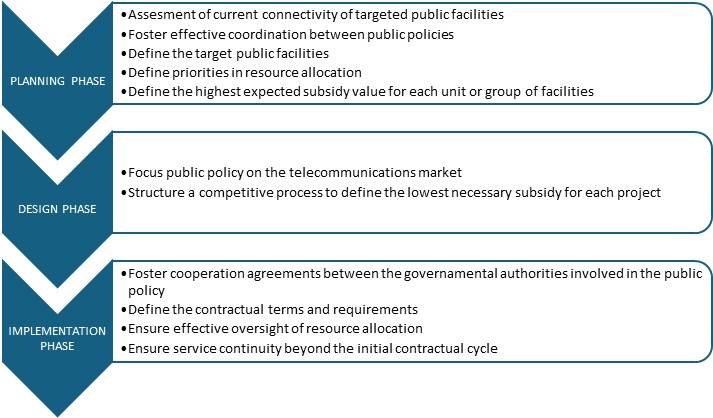
The key lessons drawn from this research are summarized below.
1. PLANNING PHASE
1.1 Reducing the asymmetry of information on subsidies – assessment of current connectivity of targeted public facilities
Effective planning for expanding telecommunications infrastructure in public facilities requires a comprehensive assessment of both existing connectivity conditions and the specific demands of each institution, as they can vary significantly — especially across facilities serving different functions, such as hospitals, police stations, or administrative offices. Reliable and accurate data must support the planning process, including georeferenced network coverage, institutional needs, and infrastructure availability. The engagement of key stakeholders — such as institutional leaders, local and regional policymakers, and sector representatives — is also essential for reducing information asymmetries and ensuring that policies effectively address the actual requirements of public facilities.
| Kenya’s Universal Fund reverse auctions involve consultation with local stakeholders and the telecoms sector to determine the scope, locations and details of the projects to be subsidized, thereby reducing information asymmetries about the subsidy.[2] |
1.2 Coordination of public policies
Effective coordination between initiatives aiming at expanding telecommunications infrastructure and related public policies is essential to avoid duplication of efforts and redundant infrastructure investments. Coordination enhances the provision of services, training, and equipment necessary for public institutions to maximize the benefits of connectivity.
| In the Brazilian initiatives funded by the 5G Auction, public tender procedures were divided into three distinct areas: (i) satellite internet services,[3] (ii) terrestrial network services,[4] and (iii) IT equipment supply.[5] This segmentation enables specialized management of each contract, enhancing service quality, promoting transparency, and facilitating independent monitoring and evaluation – thus reinforcing technical integrity of the projects. |
1.3 Definition of the target public facilities – grouping decisions to achieve efficient allocation of resources
Expanding telecommunications infrastructure requires a thoughtful approach to defining target groups and considering economic and operational factors. Larger facility groupings offer economies of scale and operational efficiencies. Targeting a single institution or a narrower group enables more accurate subsidy allocation and potentially enhances competition. An alternative approach is to delegate grouping decisions to competitive bidding. Ultimately, the selection of the most suitable model should be guided by local and regional dynamics, with proper planning needed to effectively allocate resources and select the most appropriate financing option.
| Chile’s Connectivity for Education Project offers an insightful example. Launched in 2011, the project employed a competitive model that allowed companies to propose services to a list of schools, enabling them to group the schools based on individual preferences, risking exclusion of remote or hard-to-connect schools.[6] By 2030, a “geographical zones” approach mandated companies to cover all schools within a designated zone, ensuring equitable access by requiring service provision to remote and complex institutions.[7] |
1.4 Defining priorities in resource allocation
Expanding telecommunications infrastructure demands careful resource allocation, and balancing efficiency to maximize social impact. Priorities should focus on cost-effectiveness, considering the potential of modest subsidies to attract private investment in underserved regions. Targeting areas with low negative Net Present Value (“NPV”) but high local impact can attract substantive private capital, expanding coverage while minimizing public expenditure.
1.5 Definition of the highest expected subsidy value for each unit or group of public facilities
Program managers should estimate the maximum expected value for each unit or group to guide prioritization and set subsidy limits, reducing over-allocating in low-competition areas. In doing so, two approaches can be implemented. The first one uses reference values to approximate the cost of telecommunications services in a given location. While not precise, this method suits projects without alternative revenue streams, fully dependent on public funding. The second one, based on NPV estimates, calculates subsidies more precisely by assessing the project’s negative profitability, clarifying the viability of leveraging public funding to attract private investment. NPV estimates can enhance transparency, enabling private operators to assess economic viability, identify investment opportunities, and innovate with efficient technological solutions. By capping subsidies at the negative NPV, competitive processes can lower project costs through cost-reducing innovations and alternative revenue streams to be tapped by private providers.
2. DESIGN PHASE
2.1 Focus on the telecommunications market
Focusing public policy on the telecommunications market can reduce subsidy needs. Subsidies should focus on the provision and operation of telecommunications networks and services, as combining telecommunications services with ancillary activities (e.g., supplying computers and teacher training) in a single contract can reduce competition by encouraging intermediaries who subcontract specialized services. Additionally, sharing infrastructure between providers can reduce the need for new network deployments and decrease the negative NPV of projects.
2.2 Structuring a competitive process to define the lowest necessary subsidy for each project
The lack of detailed data on subsidy needs, existing infrastructure, and private providers’ business plans poses challenges for public policies. Competitive processes like reverse auctions can address these issues by fostering competition, reducing information asymmetry, and enabling more accurate subsidy estimates. These processes help ensure subsidies target the non-recoverable investment portions. They can be designed flexibly, incorporating factors such as fibre access, criteria balancing price and technology (as in technical and price bidding process, prioritizing optical fibre when economically more advantageous), and phased implementation to address project needs and institutional requirements.
| The results of reverse auctions in Brazil highlight the ability to efficiently use scarce resources: (a) the maximum amount for the Connected Schools Project was R$66 million, with selected proposals totaling R$56.7 million;[8] (b) for the Connected Generation Program, the maximum was R$69.3 million, and the winning bid was R$62.5 million; and (c) in the 4G Public Tender Rules project, the initial amount was R$108.8 million, but the reverse auction resulted in a 41% discount on the projected value.[9] |
3. IMPLEMENTATION PHASE
3.1 Conclusion of cooperation agreements between the governmental authorities involved
Another key challenge is the limited direct involvement of government bodies responsible for the facilities in the contractual process. This lack of engagement can hinder coordination, make identifying responsible counterparts across entities challenging, and complicate the sharing of administrative and supervisory responsibilities. To address this, formal, cooperative agreements between the responsible entities and the beneficiary institutions (e.g. schools, hospitals, police facilities) are essential, ensuring clear roles for each party, streamlined coordination, and effective oversight.
3.2 Defining the contractual terms and requirements
The contractual structure between funding authorities and telecommunications companies should balance interests, compensating operators for unrecoverable costs in subsidized locations. Contracts should specify timelines for network deployment and service provision, tailored to the project’s complexity. Quality standards, such as minimum broadband speeds, availability, latency, and response times, should be specified, along with clauses for automatic service upgrades if the provider improves offerings in the area. Performance monitoring mechanisms, including real-time tracking systems, audits, and satisfaction surveys, are also essential for ensuring compliance and service quality.
3.3 Ensuring effective oversight of resource allocation
Compliance with telecommunications infrastructure expansion projects requires a robust monitoring and broadband/infrastructure mapping system. Network performance and speed monitoring mechanisms are vital for tracking connectivity performance, supplemented by regular reports. To verify proper infrastructure implementation, detailed documentation on the location and configuration of the institutions is necessary for audits and compliance checks. Integrating user feedback platforms can also strengthen transparency and community engagement. Establishing a centralized management unit operated directly by the service provider responsible for the connectivity expansion for real-time monitoring would streamline the oversight. This unit would detect trends, anticipate challenges, and facilitate fast problem resolution. Moreover, incorporating enforceable Service Level Agreements (SLAs) as monitoring parameters alongside other performance indicators can also enhance operational efficiency and accountability.
| In the Brazilian Connected Generation Project, the beneficiary must set up an operating and monitoring station staffed by a qualified technician for connectivity operation and periodically submit reports on availability rates, as well as an analytical report on any failures.[10] |
| In Colombia’s reverse auctions for the expansion of telecommunications infrastructure, in some cases the beneficiary must submit reports on the installation of the network access point and be subject to local inspections;[11] in others the contractor must provide a tool to allow remote monitoring of the operation and quality of Internet access.[12] |
3.4 Ensuring service continuity beyond the initial contractual cycle
The long-term success of telecommunications infrastructure expansion demands sustainable financing mechanisms and continuous program stability beyond the contractual cycle. When resources from universal service funds are not sufficient to expand telecommunications infrastructure to public facilities, and countries rely on alternative sources such as obligations derived from spectrum auctions, a centralized and specialized entity — distinct from the regulator or universal service agency — dedicated to managing and allocating resources would help to ensure efficient and responsive deployment aligned with national digital inclusion goals. Such centralization, however, requires a well-defined, transparent oversight framework to balance efficiency, equity, and accountability. Policy design should also consider transitioning from subsidized services to self-sustaining, market-based solutions after contract expiration to maintain service continuity. Additionally, beneficiary public institutions must retain the internal network equipment (e.g. routers and cables) to avoid disruptions, reduce installation costs, and ease the shift to new providers. Public tender rules should also create incentives for the upgrade of installed technology, ensuring that infrastructure remains adaptable to evolving technological demands.
Source: Sustainable Models for the Expansion of Telecommunication/ICT Infrastructure in Public Facilities: Best Practices and Recommendations (to be released soon here)
The recommendations outlined in the study and highlighted in this article serve as guidelines for the effective design of future public policies aimed at expanding telecommunications infrastructures. Key takeaways include the need for detailed and transparent data to support planning, improved coordination among government entities to avoid inefficiencies, and the strategic grouping of institutions to balance cost-effectiveness and competition. The study also emphasizes focusing subsidies on telecommunications services rather than bundling them with ancillary activities, adopting competitive selection processes such as reverse auctions to improve efficiency, and implementing robust oversight and performance monitoring mechanisms. Finally, long-term sustainability could be addressed through centralized resource management, clear service continuity strategies, and contractual incentives for infrastructure upgrades. By integrating them into their frameworks, policymakers can optimize the impact of investments, mitigate digital inequalities, and foster more inclusive and sustainable development.
REFERENCES:
BRAZIL. Ministry of Education. Medidor Educação Conectada. Accessed on: December 19, 2024.
BRAZIL. National Bank for Economic and Social Development. Escolas Conectadas. Accessed on: December 15, 2024.
BRAZIL. National Telecommunications Agency. Painel de Dados. Accessed on: December 20, 2024.
BRAZIL. School Connectivity Management Entity. RFP – Solicitação de Proposta para fornecimento de Serviços de Acesso a Internet via Satélite em Escolas. Accessed on: December 24, 2024.
BRAZIL. School Connectivity Management Entity. Especificação Técnica para Contratação de Serviços de Conectividade em Escolas (RFP). Accessed on: December 24, 2024.
BRAZIL. School Connectivity Management Entity. RFP – Solicitação de Proposta para o fornecimento de Equipamentos de Informática e Acessórios. Accessed on: December 24, 2024.
CHILE. Ministry of Education. Preguntas Frecuentes Nº2 Etapas de Selección y Suscripción del Convenio. Accessed on: December 05, 2024.
CHILE. Undersecretariat of Telecommunications. Bases Especificas Concurso Publico para la Asignacion del Servicio de Transmision de Datos con Acceso a Internet del Proyecto “Conectividad para la Educacion” Correspondiente al Programa Anual de Proyectos Subidiables del Año 2011 del Fondo de Desarrollo de las Telecomunicaciones. Accessed on: December 11, 2024.
COLOMBIA. Processo de Selección Abreviada Mediante Subasta Inversa Presencial No. FLO-SASI-007-2018: Prestación del Servicio de Conectividad a Internet para los Estabelecimientos Educativos Oficiales del Municipio de Floridablanca, em Cumplimiento de los Parámetros Establecidos por el Programa de Conexión Total del Ministerio de Educación Nacional. 2018.
COLOMBIA. Selección Abreviada Mediante Subasta Inversa Presencial No. 73 de 2011: Prestación de Servicio de Conectividad a Internet y Mejoramiento de la Infraestructura en Instituciones Educativas Oficiales del Municipio de Barrancabermeja. 2011.
INTERNATIONAL TELECOMMUNICATION UNION. Global Connectivity Report 2022. Accessed on: January 07, 2025.
KENYA. Universal Service Fund (USF) Framework. Accessed on: April 23, 2025.
Rio Grande do Norte Department of Education, Culture, Sport and Leisure. Pregão Eletrônico 41/2022. 2022, p. 37.
TELE.SÍNTESE. Leilão reverso de cobertura móvel tem concorrência em 45 localidades. Accessed on: December 15, 2024.
- Available here: Sustainable economic models for infrastructure expansion in underserved areas in Brazil . Developed with the support of the United Kingdom Foreign, Commonwealth and Development Office. ↑
- KENYA. Universal Service Fund (USF) Framework. Accessed on: April 23, 2025. ↑
- For the public tender procedure in Portuguese, please visit: BRAZIL. School Connectivity Management Entity. RFP – Solicitação de Proposta para fornecimento de Serviços de Acesso a Internet via Satélite em Escolas. Accessed on: December 24, 2024. ↑
- For the public tender procedure in Portuguese, please visit: BRAZIL. School Connectivity Management Entity. Especificação Técnica para Contratação de Serviços de Conectividade em Escolas (RFP). Accessed on: December 24, 2024 ↑
- For the public tender procedure in Portuguese, please visit: BRAZIL. School Connectivity Management Entity. RFP – Solicitação de Proposta para o fornecimento de Equipamentos de Informática e Acessórios. Accessed on: December 24, 2024. ↑
- CHILE. Undersecretariat of Telecommunications. Bases Especificas Concurso Publico para la Asignacion del Servicio de Transmision de Datos con Acceso a Internet del Proyecto “Conectividad para la Educacion” Correspondiente al Programa Anual de Proyectos Subidiables del Año 2011 del Fondo de Desarrollo de las Telecomunicaciones. Accessed on: December 11, 2024. ↑
- CHILE. Ministry of Education. Preguntas Frecuentes Nº2 Etapas de Selección y Suscripción del Convenio. Accessed on: December 05, 2024. ↑
- BRAZIL. National Bank for Economic and Social Development. Escolas Conectadas. Accessed on: December 15, 2024. ↑
- TELE.SÍNTESE. Leilão reverso de cobertura móvel tem concorrência em 45 localidades. Accessed on: December 15, 2024. ↑
- Rio Grande do Norte Department of Education, Culture, Sport and Leisure. Pregão Eletrônico 41/2022. 2022, p. 37. ↑
- COLOMBIA. Processo de Selección Abreviada Mediante Subasta Inversa Presencial No. FLO-SASI-007-2018: Prestación del Servicio de Conectividad a Internet para los Estabelecimientos Educativos Oficiales del Municipio de Floridablanca, em Cumplimiento de los Parámetros Establecidos por el Programa de Conexión Total del Ministerio de Educación Nacional. 2018, p. 70. ↑
- COLOMBIA. Selección Abreviada Mediante Subasta Inversa Presencial No. 73 de 2011: Prestación de Servicio de Conectividad a Internet y Mejoramiento de la Infraestructura en Instituciones Educativas Oficiales del Municipio de Barrancabermeja. 2011, p.3. ↑