Digital Regulation Platform
«
»
«
»
Innovative approaches to sector regulation

Innovative approaches to sector regulation

Innovative spectrum use rules Simply applying existing – and potentially outdated – regulation to new digital technologies and services risks stifling innovation. To better keep pace with technological developments, policy-makers are examining different measures to provide clear, flexible, and objectively applied rules that avoid hampering progress. Among the increasing trends toward light-touch and experimental regulatory models are innovative ways to use spectrum, license new technologies, and facilitate universal access. As new wireless technologies enter the field with existing services, there is an ever-increasing demand for spectrum, including for commercial 5G, satellite services, and fixed wireless, as well as increased spectrum…

Read »
GSR best practices guidelines on the gold standard for digital regulation (2020) and to fast forward digital connectivity (2019)

GSR best practices guidelines on the gold standard for digital regulation (2020) and to fast forward digital connectivity (2019)

Regulators participating in the 19th and 20th edition of the Global Symposium for Regulators adopted the following best practice guidelines to set the gold standard for digital regulation and to fast forward digital connectivity. Regulatory best practice guidelines to set the gold standard for digital regulation 1 Demonstrating regulatory thought leadership for digital transformation While recognizing that digital regulation will be led by the core policy design principles outlined in the GSR-19 Best Practice Guidelines to fast forward digital connectivity for all, we identified the following fundamentals for sound, future-proof regulatory frameworks to respond to the challenges of digital transformation…

Read »
GSR BPG on regulatory uplift for financing digital

GSR BPG on regulatory uplift for financing digital

GSR-21 Best practice guidelines on Regulatory uplift for financing digital infrastructure, access and use Digital technologies are now powering our economies and the way we live – our very future. Digitalization is fast revolutionizing productivity, employment, skills, services and markets. It changes the means of production, methods of delivery, lifestyles, patterns of consumption and the fabric of social intercourse. ICTs are now the foundation for every economic sector, for business performance and for national growth. This change is profound. Collaborative digital regulation addresses the complexity and the opportunity of this change through flexible and enabling policy frameworks. The COVID-19 pandemic…

Read »

Deep Dive: Collaboration between competition and ICT authorities

Importance of ICT regulator and competition authority collaboration As noted in Intragovernmental Collaboration, a common area of overlap between vertical and horizontal regulatory approaches is competition in the ICT sector. As such, competition and ICT regulators often work together to achieve common goals in line with their mandates. In some cases, cooperation tools are envisaged in legislation, other times agencies frame them in formal agreements, such as MOUs/MOAs, and in other cases regulators choose to cooperate informally. Often, informal cooperation is the precursor to future – and formal – cooperation. Collaboration between ICT and competition regulators is a common and…

Read »

Deep Dive: Common elements of collaboration agreements between agencies

An inter-agency collaboration agreement is a written agreement between two or more parties, outlining the terms of collaboration or cooperation to reach one or more common objectives. Such agreements, frequently drafted as an MOU or a Memorandum of Agreement (MOA), establish a legal basis for collaboration and outline participants’ roles and functions; responsibilities; allocation of funds; and short-, medium- and long-term goals. Typical provisions might also include processes for inter-agency information-sharing, investigations, enforcement, training, and external outreach (DHS 2006). MOUs or MOAs used by ICT regulators can include the following components: an introduction to the specific policy problem addressed by…

Read »
Deep Dive: Industry codes of practice

Deep Dive: Industry codes of practice

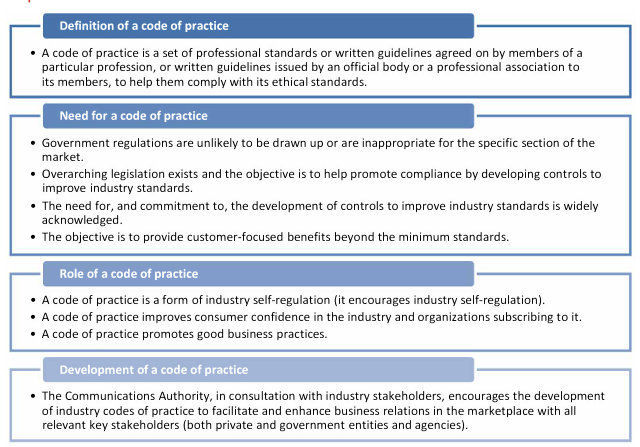
Intended as a complement to rules-based regulatory models, industry codes of practice can help establish clear regulatory goals and best practices. According to the Kenya Communications Authority‘s (CA) approach to developing codes of practice, the mechanism is defined as “a set of professional standards or written guidelines agreed on by members of a particular profession, or written guidelines issued by an official body or a professional association to its member, to help them comply with its ethical standards” (ITU 2023). The Kenya Communications Authority’s approach to developing codes of practice Source: ITU, Collaborative regulation for digital transformation in Kenya: A…

Read »

National approaches to RIA: Australia, Brazil and United Kingdom

Theme: Regulatory governance Type: Section Date: 2025-08-26 As with policy initiatives and regulatory regimes, there is no “one size fits all” approach to conducting RIAs. While basic principles and processes apply in all cases, each country adapts these practices to their own unique needs, capacities, and legal frameworks. The following case studies from Australia, Brazil, Rwanda, and the United Kingdom showcase the similarities, difference, and outcomes of RIA processes around the world. In each instance, governmental authorities have published written, comprehensive guides, procedural rules, or statutory instruments requiring RIAs specifically (and potentially EBDM more broadly). Whether adopting government-wide or agency-specific…

Read »

Country case studies: Good practices in EBDM

Theme: Regulatory governance Type: Section Date: 2025-08-26 To provide further insight into how policymakers and regulators may incorporate EBDM and RIAs into their decision-making processes, five country case studies are highlighted below as they represent good practices. Canada and South Africa provide examples of good EBDM practices while Australia, Brazil, and the United Kingdom show how regulators may approach RIAs. EBDM case studies: Canada and South Africa Canada and South Africa have taken an “all-of-government” approach to implementing EBDM across sectors by adopting regulations that apply to all ministries and regulators. The fundamental principles represented in the national regulations on…

Read »

Related resources

Regulatory databases World Bank body of knowledge on infrastructure regulationWorld Bank global indicators of regulatory governanceITU ICT Regulatory TrackerITU ICT Eye Publications

Read »