Digital Regulation Platform
Developing a telecommunications/ ICT contingency plan for a pandemic response

Developing a telecommunications/ ICT contingency plan for a pandemic response

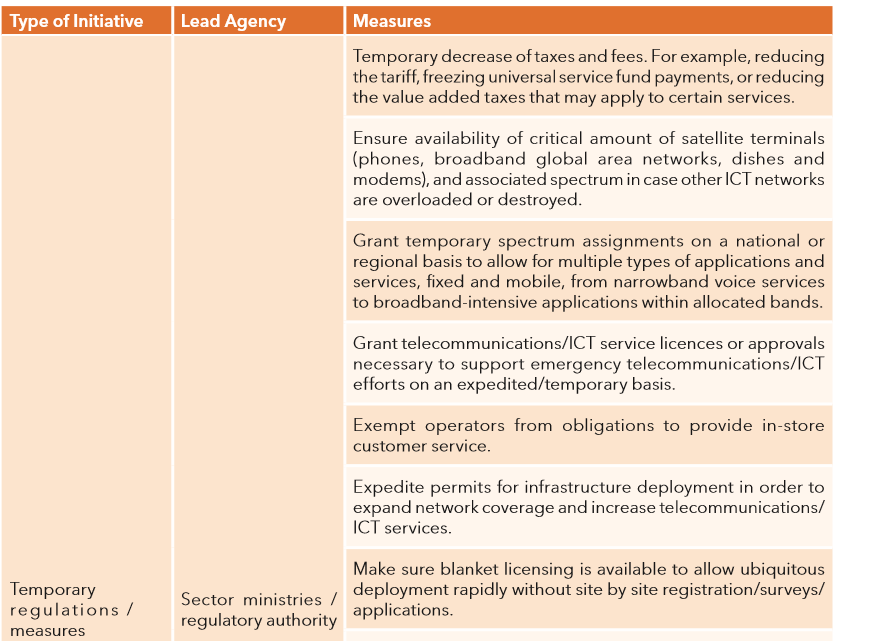
(Adapted from the ITU Guide to develop a telecommunications/ ICT contingency plan for a pandemic response) Summary The Covid-19 crisis has demonstrated the essential role of connectivity worldwide and the importance of having telecommunications and ICT in place for coordination mechanisms to respond to it. The response has demonstrated the strategic importance of a robust, resilient, and secure telecommunications/ICT infrastructure to social welfare and the global economy. This pandemic is the biggest global health crisis in decades. All government agencies and stakeholders involved in disaster risk management, including government decision-makers and the community in general should deploy coordination mechanisms and…

Read »

Pakistan’s Universal Service Fund

Pakistan’s Universal Service Fund

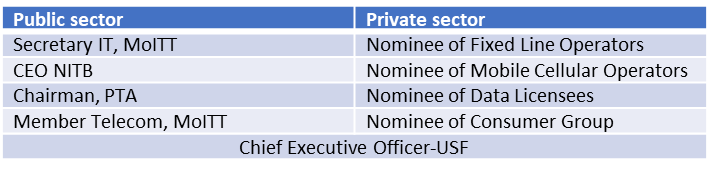
UA funding and financing policies: tackling accessibility challenges Pakistan established an autonomous Universal Service Fund (USF) by the end of 2006, in accordance with rules and guidelines from the Telecommunications Law enacted in July 2003, the 2004 Mobile Cellular Policy, and the 2004 Broadband Policy. It was created by the Ministry of Information Technology and Telecommunication (MoITT) with the goal of promoting the development of telecommunication services in unserved and underserved areas throughout the country. The USF follows a Corporate Model under Section 42 of the Pakistani Companies Ordinance. The main objectives of the USF are: to make telecommunication operators…

Read »

Mitigation phase: infrastructure duplication, resource sharing, and regulatory forbearance

Infrastructure duplication Making networks resilient calls for the elimination of single points of failure, especially for backbone cables and critical equipment such as authentication servers (ITU 2014). Costs can be reduced by ensuring that competing operators have their own separately routed and equipped networks but agree that after a disaster they will make their networks available to each other. Such arrangements need care, both because they could weaken competition and because routes that are disjointed in one layer of a network could well be sharing a lower layer. However, having separately routed networks is not enough: there should actually be…

Read »

Preparedness phase: community outreach

Community outreach Operators can be expected to tell their customers about their own products, but not necessarily about communications more generally. Information needs to be repeated for each generation. For instance, at the time of the Tōhoku earthquake and tsunami, 21 per cent of the public in Japan did not know about the phone and Internet message boards (for sharing knowledge of casualties) and 91 per cent had not used them, though they had existed for about twenty years (ITU 2013). The regulator should require that operators inform not just their employees but also their customers about the telecommunications plan…

Read »

Recovery phase: infrastructure reconstruction

Infrastructure reconstruction Reconstruction of the telecommunications infrastructure should follow soon after the disaster, and should consider rebuilding more resilient telecommunication/ICT network infrastructure and include potential redundant network deployments wherever possible to prepare for future disasters. Government and the private sector should also take advantage of the opportunity to rebuild relevant telecommunication/ICT infrastructure, and where possible, to deploy technologies that are more resilient, efficient, and less expensive (ITU 2020). For post-disaster needs assessments, there is a guide oriented to costing replacements for damaged telecommunications equipment and infrastructure (PDNA 2014). Also, reconstruction might present many opportunities for improvement. For instance: Weaknesses exposed…

Read »

Recovery phase: communication evolution

Public Protection and Disaster Relief Telecommunication/ICT used in responses to disasters depends heavily on wireless technologies. It is therefore related closely to Public Protection and Disaster Relief (PPDR), which has been defined to combine both, Public Protection (PP) radiocommunication used when dealing with maintenance of law and order, protection of life and property, and emergency situations; and Disaster Relief (DR) radiocommunication used when dealing with a serious disruption in the functioning of society, posing a significant, widespread threat to human life, health, property, or the environment (ITU 2017). In the past, PPDR has been implemented using special-purpose networks and terminals,…

Read »

Preparedness phase: hazard monitoring

Monitoring environmental conditions using specialized equipment has long been a necessary part of preparedness. Equipment has been falling in cost and rising in capability. There are now many cheap and portable sensors and actuators available in Internet of Things (IoT) devices that can be powered using solar panels or long-life batteries and that can communicate over long-range wireless networks. They are well suited to risky and remote locations. Even if they do not individually provide information of the same quality and quantity as more expensive equipment, they can compensate by being installed in bulk and communicating their information to systems…

Read »

Chile’s Telecommunications Development Fund: monitoring and evaluation

Payment milestones linked to project progress UA policy and project monitoring is a key policy element that can and should be fundamental to any program that disburses public funds for the development of telecommunications services. In Chile, the Telecommunications Development Fund (FDT) is governed by a regulation that explicitly requires government certification of project completion before subsidy funds can be released. The FDT regulation notes that, in order for a UASF subsidy to be paid, the concessionaire, permit holder or licensee must present the certificate granted by the Undersecretariat of Telecommunications (SUBTEL) certifying that the work has been correctly executed…

Read »

Indonesia’s Universal Service Obligation Fund

Introduction One of the main challenges to developing ICT Infrastructure in Indonesia is its geography. This includes the number of islands, size of the territory to cover, the numerous remote and difficult to reach areas, and the number of low-income and uneducated inhabitants (GSMA 2013: 151). Owing to the limited funding capability of both the government and the private sector, infrastructure development cannot fully meet the demand in Indonesia. Thus, isolated and impoverished parts of the country are the most harmed (GSMA 2013: 151). Structure According to Telecommunications Law No. 36 of 1999, “every telecommunications network operator and/or telecommunications service…

Read »
Norway: experiences in regulatory collaboration

Norway: experiences in regulatory collaboration

Regulatory collaboration among sectoral regulators Source: Bergen, Norway. Photo by Mikita Krasiou on Unsplash According to the International Telecommunication Union (ITU) Benchmark of Fifth Generation Collaborative Regulation (G5 Benchmark), Norway is the world’s leading G5 regulator (ITU 2020). The ITU also ranks Norway as one of the top countries in terms of harnessing the value of collaboration in digital markets regulation. This position is shared with Botswana, Singapore, and the United Kingdom. Accordingly, Norway’s mature ICT regulatory framework and its ability to consistently develop synergies between digital services and cross-sectoral collaboration have led the ITU to identify Norway as a…

Read »